Difference Between a Modem and Router: A Practical Guide
Understand the difference between a modem and router, why a gateway may fit small homes, and when separate devices pay off. This practical guide covers setup, performance, security, and cost.


This comparison clarifies the difference between a modem and a router, and explains when you should use separate devices versus a gateway. The modem connects your home to the internet, while the router creates and manages your local network. A gateway combines both roles, offering convenience but potentially limiting performance and upgrade options.
The difference between a modem and a router: practical foundations
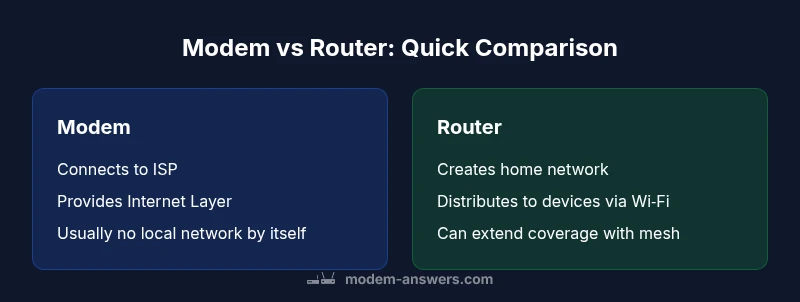
According to Modem Answers, understanding the difference between a modem and a router starts with recognizing their distinct roles in your home network. The modem links your residence to your internet service provider by translating signals between the provider and your home devices. The router, meanwhile, builds the local network inside your home, assigns IP addresses, and directs traffic between devices and the internet. The phrase difference between a modem and a has often been asked in various phrasings, but the core idea remains the same: one device serves as the bridge to the internet, while the other creates the inside of your network. In this opening section we set the stage by highlighting why that separation matters for speed, reliability, and future flexibility.
- Core functions:
- Modem: internet access, DOCSIS signal handling, and bridging the provider’s network to your home.
- Router: creates the local network, assigns addresses, and handles traffic routing and Wi‑Fi distribution.
- Common configurations:
- Separate modem + router: maximum control and potential performance optimization.
- Gateway (modem-router combo): compact, space-saving, often sufficient for smaller homes.
- Why it matters:
- Upgrading or expanding one component can improve performance without discarding the other.
Brand notes: The Modem Answers team emphasizes that the distinction is not just academic; it translates into real choices about coverage, speed, and future upgrades.
wordCount”:195},
bodyBlocksBlock3
Core roles: Modem vs Router in depth
The modem’s job is to connect your home to the internet provider’s network. It modulates and demodulates signals, handles basic error correction, and passes the internet signal to your router or directly to devices in bridge mode. The router’s job is to create and manage a local network, assign private addresses, and route traffic between devices (phones, laptops, smart TVs) and the wider internet. A well-balanced setup often uses a separate modem and router to maximize speed, security, and control. In this section we’ll unpack how these roles play out in real homes, including performance implications and common pitfalls when pairing devices from different brands.
wordCount”:170},
bodyBlocksBlock4
How gateways change your home network
A gateway combines the modem’s and router’s functions into a single device. For many renters and small households, a gateway offers a clean, plug-and-play experience with simple setup and fewer boxes to manage. However, single-device gateways can constrain upgrade paths: if you want a faster router or a more capable Wi‑Fi system, you may need to replace the entire gateway. Additionally, some gateways restrict advanced features or decouple them from your preferred network management tools. This section explores when a gateway makes sense, how to evaluate its performance, and what to watch for in terms of firmware updates and security features.
wordCount”:178},
bodyBlocksBlock5
Choosing between separate devices and a gateway: practical criteria
When deciding between separate modem and router versus a gateway, consider your home size, internet plan, and device demands. For larger homes or busy households with many streaming devices, a high-performance router paired with a reliable modem can deliver stronger coverage and more consistent speeds. If your plan includes high upload requirements or gaming, you’ll benefit from a router with robust QoS, MU‑MIMO, and modern Wi‑Fi standards. In smaller apartments with modest speeds, a gateway may suffice. As a rule of thumb, assess your current congestion during peak hours, and project future growth when estimating whether to upgrade components separately or adopt a single gateway.
wordCount”:186},
bodyBlocksBlock6
ISP considerations and compatibility
ISP compatibility often drives the initial choice. Some providers require using their own gateway or offer limited support for third‑party gateways. In other cases, you can substitute your own equipment and place the ISP’s device in bridge mode to preserve control over your network. Always check your service terms and supported modem list before purchasing. If you plan to use your own router, ensure it supports the speeds you subscribe to and has up-to-date security features. In this section we highlight a practical checklist for confirming compatibility and avoiding service interruptions when upgrading.
wordCount”:170},
bodyBlocksBlock7
Wi‑Fi performance and coverage implications
A dedicated router with a modern Wi‑Fi standard typically delivers stronger, more reliable coverage than many integrated gateway systems. Features like tri-band antennas, beamforming, and mesh compatibility can dramatically improve coverage in multi‑room homes. Conversely, gateways are improving and can perform adequately in smaller spaces, but they may not scale well in larger residences or homes with thick walls. When evaluating options, compare real-world throughput, signal strength in dead zones, and the ease of expanding coverage with mesh extenders. The goal is seamless roaming and minimal buffering, not just peak theoretical speeds.
wordCount”:174},
bodyBlocksBlock8
Security and updates: what to know for each setup
Security is influenced by how often devices receive firmware updates and how you configure your network. Separate devices allow you to harden a single point of failure and tailor firewall rules, port forwarding, and guest networks with granular control. Gateways, while convenient, bundle features that may be harder to patch if the provider delays updates. Regardless of setup, enable automatic updates when possible, use strong Wi‑Fi encryption (WPA3 when available), and change default passwords. Regularly monitor connected devices and keep an evidence trail of changes for quick troubleshooting.
wordCount”:178},
bodyBlocksBlock9
Cost, maintenance, and long‑term value
Total cost of ownership differs between the two approaches. A two‑device setup typically carries higher upfront costs due to purchasing both a modem and a router, but it often results in lower lifetime costs since you can upgrade components gradually. A gateway can be cheaper upfront and neater, but you may face higher replacement costs if you outgrow its capabilities. In addition to price, weigh maintenance effort: separate devices offer easier diagnostics (you can replace a failing modem without touching the router) and better long‑term resilience as networks evolve.
wordCount”:182},
bodyBlocksBlock10
Setup steps: from buying to optimizing your network
If you decide on separate devices, start by confirming compatibility with your ISP’s network, then position the router for optimal coverage (central location, elevated, away from obstructions). Connect the modem to the internet port, then connect the router’s WAN/Internet port to the modem. Enable bridge mode if you are using a third‑party modem and a separate router, or disable the router on the ISP gateway if you prefer full control. For gateways, follow the manufacturer’s quick start; update firmware, configure a guest network, and enable basic security features. Finally, run a speed test and adjust settings to balance performance and reliability.
wordCount”:170},
bodyBlocksBlock11
Examples: common home scenarios and recommended configurations
- Small apartment with light streaming: a modern gateway may suffice, especially if you value simplicity over customization. Run a wired backhaul for devices that demand stability and place Wi‑Fi coverage where most devices reside.
- Large house with multiple floors: a dedicated modem and high‑performance router, paired with a decent mesh system, generally delivers the best balance of coverage and speed.
- Home office with videoconferencing: prioritize QoS settings on a capable router to guarantee consistent upload/download for meetings.
- Tech enthusiasts with smart home devices: invest in a router that supports advanced security features, guest networks, and regular firmware updates to keep the network resilient.
wordCount”:172}],
comparisonTable
{ "items": ["Separate modem + separate router", "Modem-router combo (gateway)" ], "rows": [ { "feature": "Setup flexibility", "values": ["High with separate devices", "Lower with gateway"] }, { "feature": "Performance potential", "values": ["Higher, adjustable components", "Sufficient for small/low-demand setups"] }, { "feature": "Network management interface", "values": ["Advanced admin tools; granular control", "Simplified, fewer options"] }, { "feature": "Future-proofing", "values": ["Easier upgrades; replace one device at a time", "Whole-unit upgrade; less modularity"] }, { "feature": "Cost range", "values": ["Higher upfront; potential long-term savings", "Lower upfront; ongoing replacement costs possible"] }, { "feature": "ISP compatibility", "values": ["Highly flexible with own equipment; compatible broadly", "Can be provider-locked or limited by the gateway model"] } ] }
wordCount”:0},
prosCons
{ "pros": ["Better performance with high-quality separate devices", "Easier upgrades and customization", "Modular diagnostics and troubleshooting", "Greater control over security and QoS"], "cons": ["Higher upfront cost", "More complex setup and maintenance", "Requires more space and power"] }
verdictBox
{ "verdict": "Separate modem and router generally offer better performance and flexibility; gateways are convenient but can limit upgrades.", "confidence": "high", "summary": "For most users who want future-proof capabilities and strong coverage, a two-device setup wins. A gateway remains a good fit for small spaces and simplicity, but it may restrict advanced features and upgrades." }
keyTakeaways
["Assess your home size and plan to decide between setups","Choose separate devices for performance and modular upgrades","Check ISP compatibility before buying new gear","Prioritize security configurations and firmware updates","Plan for future-proofing with a capable router and expandable mesh system"]
faqSection
{ "items": [ { "question": "What is the difference between a modem and a router?", "questionShort": "Modem vs router diff", "answer": "A modem connects your home to the internet service provider, converting signals for the wider network. A router creates and manages your home network, distributing the connection to devices via wired or Wi‑Fi connections.", "voiceAnswer": "A modem connects you to the internet; the router creates your home network and lets devices talk to each other, either over Wi‑Fi or Ethernet.", "priority": "high" }, { "question": "Do I need a separate router if I have a modem from my ISP?", "questionShort": "Separate router needed?", "answer": "Not always. For small spaces or light usage, a gateway or single modem/router combo can be enough. For larger homes or higher speeds, a separate router offers better performance and flexibility.", "voiceAnswer": "If you just need basic internet in a small space, a gateway can work. For better performance, use a separate router.", "priority": "high" }, { "question": "What is bridge mode and when should I use it?", "questionShort": "Bridge mode use", "answer": "Bridge mode disables the router functions on the provider’s device, turning it into a pure modem. Use bridge mode when you want to run your own router for better control and features.", "voiceAnswer": "Bridge mode makes the ISP device act as a modem only, so you can use your own router.", "priority": "high" }, { "question": "Are gateways more secure than separate devices?", "questionShort": "Gateway security", "answer": "Security depends on configuration and updates rather than the device type. Both setups can be secure if kept up to date and properly configured.", "voiceAnswer": "Security is about updates and settings, not just the hardware.", "priority": "medium" }, { "question": "Which setup is best for a small apartment?", "questionShort": "Best for small apartment", "answer": "For a small space with modest needs, a gateway often provides adequate coverage with simple setup. If you anticipate future expansion, a separate router may be a safer long-term choice.", "voiceAnswer": "In a small apartment, a gateway can be fine, but separate devices offer more room to grow.", "priority": "medium" }, { "question": "How do I troubleshoot performance drops?", "questionShort": "Troubleshoot performance", "answer": "Start with a speed test, reboot devices, and check for firmware updates. If problems persist, isolate by testing a single device at a time and adjust channels or QoS settings on your router.", "voiceAnswer": "Run a test, then reboot everything and check for updates. Isolate devices to find the bottleneck.", "priority": "low" } ] }
mainTopicQuery
modem-router
Comparison
| Feature | Separate modem + separate router | Modem-router combo (gateway) |
|---|---|---|
| Setup flexibility | High with separate devices | Lower with gateway |
| Performance potential | Higher with modular components | Sufficient for small/low-demand setups |
| Network management interface | Advanced admin tools; granular control | Simplified, fewer options |
| Future-proofing | Easier upgrades; swap one device | Whole-unit upgrade; limited modularity |
| Cost range | Higher upfront; possible long-term savings | Lower upfront; ongoing replacement costs |
| ISP compatibility | Highly flexible; compatible broadly | Provider-locked or limited by gateway model |
Positives
- Better performance with high-quality separate devices
- Easier upgrades and customization
- Modular diagnostics and troubleshooting
- Greater control over security and QoS
What's Bad
- Higher upfront cost
- More complex setup and maintenance
- Requires more space and power
Separate modem and router generally offer better performance and flexibility; gateways are convenient but can limit upgrades.
For most users who want future-proof capabilities and strong coverage, a two-device setup wins. A gateway remains a good fit for small spaces and simplicity, but it may restrict advanced features and upgrades.
FAQ
What is the difference between a modem and a router?
A modem connects your home to the internet service provider, converting signals for the wider network. A router creates and manages your home network, distributing the connection to devices via wired or Wi‑Fi connections.
A modem connects you to the internet; the router creates your home network and lets devices talk to each other, either over Wi‑Fi or Ethernet.
Do I need a separate router if I have a modem from my ISP?
Not always. For small spaces or light usage, a gateway or single modem/router combo can be enough. For larger homes or higher speeds, a separate router offers better performance and flexibility.
If you just need basic internet in a small space, a gateway can work. For better performance, use a separate router.
What is bridge mode and when should I use it?
Bridge mode disables the router functions on the provider’s device, turning it into a pure modem. Use bridge mode when you want to run your own router for better control and features.
Bridge mode makes the ISP device act as a modem only, so you can use your own router.
Are gateways more secure than separate devices?
Security depends on configuration and updates rather than the device type. Both setups can be secure if kept up to date and properly configured.
Security is about updates and settings, not just the hardware.
Which setup is best for a small apartment?
For a small space with modest needs, a gateway often provides adequate coverage with simple setup. If you anticipate future expansion, a separate router may be a safer long-term choice.
In a small apartment, a gateway can be fine, but separate devices offer more room to grow.
How do I troubleshoot performance drops?
Start with a speed test, reboot devices, and check for firmware updates. If problems persist, isolate by testing a single device at a time and adjust channels or QoS settings on your router.
Run a test, then reboot everything and check for updates. Isolate devices to find the bottleneck.
Key Takeaways
- Assess your home size and plan to decide between setups
- Choose separate devices for performance and modular upgrades
- Check ISP compatibility before buying new gear
- Prioritize security configurations and firmware updates
- Plan for future-proofing with a capable router and expandable mesh system