How to Update Cox Modem Firmware Safely and Quickly
Learn how to perform a safe Cox modem firmware update, back up settings, and verify improvements. This step-by-step guide from Modem Answers helps homeowners keep their network secure and reliable.


This guide helps you perform a safe cox update modem firmware update. You’ll verify your current version, decide auto vs manual updates, back up settings, and complete a structured, step-by-step process to keep your network secure and stable. We’ll cover what to expect, how Cox delivers updates, common pitfalls, and post-update checks to confirm everything runs smoothly.
Understanding Cox Modem Updates
Keeping your Cox modem firmware current is a core part of home-network maintenance. The phrase cox update modem refers to the ongoing process Cox uses to push performance improvements, security fixes, and feature tweaks to compatible modems. When you stay current, your devices experience fewer disconnects, better compatibility with in-home Wi‑Fi devices, and improved resilience against known vulnerabilities. According to Modem Answers, regular updates are a best practice for homeowners who want reliable service without surprises. In practice, updates arrive automatically for many users, but you can take steps to manage them proactively, especially if you rely on complex port-forwarding or custom firewall rules. Understanding when and how these updates flow into your hardware helps you plan maintenance windows and avoid unnecessary downtime.
Check Your Current Firmware Version
Before you update, identify the exact firmware version running on your Cox modem. Start by opening the Cox My Account app or signing into the Cox device management portal. Look for a section labeled 'Device' or 'Modem' and note the firmware version, build number, and the date of the last update. If you see a version that matches Cox's published release notes, you may already be current. If not, compare the version against Cox's official update notes to determine whether an update is available. Keeping a record of your current version makes it easier to confirm that an update has taken effect after the reboot. If you need help, you can share your version with a support agent to verify compatibility and walk you through manual update steps.
How Cox Delivers Updates (Auto vs Manual)
Cox typically delivers updates automatically when your modem is online and eligible; for many users, auto-update is sufficient and unobtrusive. However, some customers prefer manual control, especially if uptime is critical or if you manage a more complex home network. In manual mode, you can check for update availability in the Cox app or the modem’s admin interface and initiate the install yourself. Either way, the update process generally involves a short restart and a temporary loss of connectivity. The important part is to ensure you have a recent backup, a stable power source, and a plan to verify your network after the update.
Precautions Before Updating
Back up important settings such as your Wi‑Fi network name (SSID) and password, any port-forwarding rules, DMZ configurations, and custom firewall settings. Recording these details enables a quick restoration if the update resets the modem to defaults. Prepare a stable power source; a brief loss of power during an update can corrupt firmware. If possible, connect the modem with a wired Ethernet cable to a reliable router or computer to reduce update interruptions. Consider the impact on any bridging or network-mode configurations you use, since updates can alter these settings.
Troubleshooting Common Update Problems
Sometimes an update won’t install on the first attempt. If the progress bar stalls, wait a few minutes, then retry. A recurring failure may require a factory reboot, but only perform this after backing up configurations. If you suspect a problem with the update, check Cox’s status pages or contact Cox support. For some users, updating via the Cox app can fail due to a mobile connection issue; try a direct web portal connection from a computer. If you have smart-home hubs or IoT devices, temporarily disconnect them to ensure the modem update doesn’t trigger unexpected behavior.
Post-Update Checks: Verify Performance and Security
After the update completes, reboot the modem if it doesn’t automatically restart, and recheck your firmware version to confirm the change. Test your internet connection with a quick speed-test from multiple devices and perform basic tasks (streaming, video conferencing, gaming) to verify stability. Reconfirm your Wi‑Fi network name and password, and reapply any port-forwarding rules as needed. Monitor your network for unusual activity and review Cox’s release notes for any newly supported features. By performing these checks, you’ll confirm the update is functioning as intended and maintain the security position of your home network.
Authoritative sources
For further reading and verification, consult government and standards bodies that guide device firmware and home network security:
- FCC: https://www.fcc.gov
- CISA: https://www.cisa.gov
- NIST: https://www.nist.gov
These sources provide general principles that align with best practices when updating consumer networking hardware. Always cross-check Cox’s official update notes with these standards to ensure your process remains secure and up-to-date.
Tools & Materials
- Computer, smartphone, or tablet with internet access(Needed to access Cox My Account or Cox app and start the update)
- Cox account login credentials(Username and password for sign-in)
- Ethernet cable (recommended)(Use a wired connection to minimize drop risk during the update)
- Uninterruptible power supply (UPS) or charged backup battery(Prevents power loss during update)
- Note-taking tool (paper or digital)(Record current settings for quick restoration)
Steps
Estimated time: 20-40 minutes
- 1
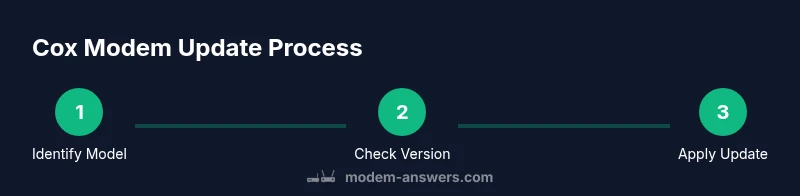
Identify your modem model
Locate the exact model number and hardware version of your Cox modem in the device label or the admin interface. This ensures you’re applying the correct update and avoiding incompatible firmware.
Tip: Note the model and version so you can reference Cox notes accurately. - 2
Check current firmware version
Use the Cox app or the modem’s admin page to view the current firmware version and build date. Compare with Cox’s release notes to decide if an update is needed.
Tip: Document the version to confirm post-update changes. - 3
Choose auto vs manual update
If auto-update is enabled, you may not need to intervene. For manual control, prepare to initiate the update from the app or web portal.
Tip: Manual updates give you control over timing and downtime. - 4
Backup modem settings
Record Wi‑Fi settings, port-forwarding, and firewall rules so you can restore them after updating.
Tip: Backups prevent losses of custom configurations. - 5
Perform the update
Initiate the update via the Cox app or web portal. Do not unplug the modem during the update; allow it to restart automatically if prompted.
Tip: If asked, opt for a restart after the update completes. - 6
Verify and finalize
After reboot, verify the firmware version, run a quick speed test, and confirm devices reconnect. Reapply any settings if needed.
Tip: Watch for a brief downtime and test multiple devices.
FAQ
Is auto-update enabled by default on Cox modems?
In many cases, auto-update is enabled by default. You can verify this in the Cox app under device settings and opt for manual updates if you need more control.
Auto-update is usually on by default; you can check the settings in the Cox app to switch to manual if you want more control.
What should I do if the update fails to install?
If an update fails, reboot the modem, retry the update, and check Cox’s status pages for outages. If problems persist, contact Cox support for guidance.
If it fails, reboot and retry. If it keeps failing, contact Cox support for help.
Will updating cause downtime for my devices?
Yes, updates typically involve a brief modem restart, which temporarily disrupts internet for all connected devices.
There’s usually a short downtime while the modem restarts, but your devices should reconnect quickly afterwards.
Can I update Cox modem using the Cox app only?
Updates can be initiated from the Cox app or the web portal. Choose the method you find most convenient and reliable.
You can update from the Cox app or the web portal—pick the method you prefer.
Do firmware updates improve security and performance?
Firmware updates typically address security vulnerabilities and performance improvements. Keeping firmware current reduces risk and enhances stability.
Yes, updates often fix security issues and improve performance.
How long does a Cox modem firmware update take?
Most updates take just a few minutes, though longer updates occasionally occur. Plan for up to 30 minutes and monitor the progress.
Most updates take a few minutes, but in some cases up to half an hour.
Watch Video
Key Takeaways
- Back up settings before updating
- Prefer a wired connection for reliability
- Verify firmware version after update
- Check network performance with tests
- Consult official notes for new features