Where to Internet Modem: A Practical Guide for Homeowners
Discover practical options for obtaining an internet modem—offline retailers, online shops, or rental programs. Learn how to compare compatibility, DOCSIS standards, and ownership costs for homeowners and renters.


Where to internet modem? You can buy a modem at major retailers (Amazon, Best Buy, Walmart), online via manufacturer sites, or rent directly from your internet service provider. For most households, buying a compatible modem saves ongoing rental fees, but you should verify compatibility with your ISP and DOCSIS standard.
Where to internet modem fits in your home network
Choosing where to internet modem fits into your home network starts with understanding the available purchasing channels and how they affect price, support, and future-proofing. In practice, most households begin by asking where to internet modem — offline stores, online shops, or rental programs from the provider. The right choice balances upfront cost, long-term savings, and compatibility with the local service. The Modem Answers team notes that consumers should prioritize devices that are compatible with their ISP, support the required DOCSIS standard, and have a reasonable warranty. For many, buying a modem upfront eliminates recurring rental fees and reduces monthly bills, but it requires confirming service readiness and potential activation steps.
If you’re unsure where to start, the first step is to verify your service address and the provider you use. This helps you exclude models that aren’t supported locally. Remember that “where to internet modem” is less about the store location and more about choosing an option that aligns with your usage, future upgrade plans, and how you prefer to manage devices in your home network.
Offline purchase options: big-box retailers and carriers
Offline shopping remains a strong option for many homeowners who value immediate hands-on inspection and straightforward returns. Big-box retailers and carrier stores typically offer a curated selection of modems, often with clear on-site activation steps. When you visit these stores, you can physically compare form factors, check for visible indicators of build quality, and speak with staff about compatibility reminders. Offline purchases also give you the advantage of instant exchange if a device arrives DOA (dead on arrival) or fails activation. If you’re shopping offline, bring your ISP name, your plan speed, and any activation requirements so staff can guide you toward devices that meet those criteria. As a rule, verify that the model is listed as compatible with your service on the provider’s site before leaving the store.
Online shopping: manufacturer sites and marketplaces
Online channels provide the broadest selection and often the best prices. Manufacturer sites, large marketplaces, and authorized resellers regularly post updated compatibility lists and warranty terms. Shopping online makes it easy to compare specs side-by-side, read user reviews, and check for promotional bundles that include a router or basic security features. When you buy online, confirm the modem’s compatibility with your exact plan and speed tier, and review return policies and activation steps. Online purchases frequently require self-activation steps (either via the provider’s portal or a pre-activated device), so set aside time to complete setup after delivery.
For the quick decision, prioritize models that appear on your ISP’s official compatibility list and have a clear activation path documented by the seller.
Renting vs buying: cost and long-term value
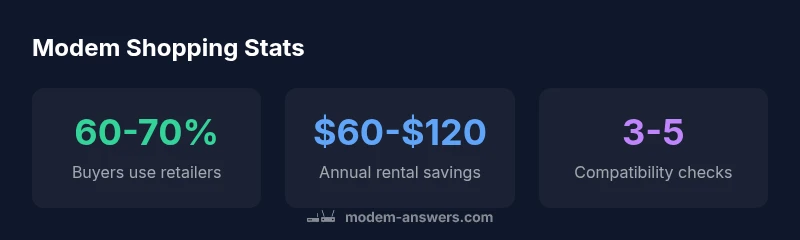
Renting from your ISP is convenient and hands-off. The monthly fee covers support and occasional replacements, but over a multi-year period, renting often costs more than buying. If you plan to stay in your current home for several years, buying a compatible modem can reduce total ownership costs and give you more control over firmware updates and device placement. However, if you anticipate moving soon, renting might be simpler because you can return the device without worrying about resale value. Consider the total cost of ownership, including potential activation fees, warranty coverage, and the cost of a future upgrade when your plan or speeds increase.
If you choose to buy, you won’t be locked into a rental agreement, but you should keep track of firmware support and replacement timelines so you stay current with security features and performance improvements.
Compatibility checks you should run before purchase
Before purchasing, perform a quick set of checks to avoid post-purchase friction. First, verify DOCSIS support (3.0 or 3.1 is common today) and ensure the selected modem supports your plan’s speed tier. Second, confirm that the modem is on your ISP’s official compatibility list; this minimizes activation issues and guarantees support if you need assistance. Third, check for the presence of a telephone line port if you rely on voice services that use your modem, and ensure the device has adequate Ethernet ports for your home network. Finally, review the warranty period and the seller’s activation process so you can plan for a smooth start. When in doubt, contact your ISP and ask for a short compatibility checklist to bring with you to the store or include in your online cart.
What to look for in a modem: key features and specs
When evaluating models, look beyond the basic price tag. Key features include DOCSIS standard (3.0/3.1), channel bonding capacity, supported frequency ranges, and energy efficiency. A robust modem should have secure boot, future-proof firmware update support, and clear documentation for activation. If you want to pair it with your existing router, consider a modem that supports bridge mode, or buy a modem-router combo if you prefer a simplified setup. Also check the thermal design and build quality, as these influence longevity. Finally, consider warranty duration and the ease of obtaining replacement devices from retailers or manufacturers. Selecting a model with good support documentation can save time and frustration during setup.
Budgeting and ownership costs: planning your total spend
Budgeting for a modem means weighing upfront cost against ongoing rental fees. Use a simple calculation: if your monthly rental is $10-$15, buying a device at $60-$150 can pay for itself in a year or two. However, your own usage patterns matter: heavy streaming, smart-home devices, and future speed bumps can justify a higher upfront investment for a more capable modem. When planning, include potential activation or shipping fees, and set aside funds for future firmware updates or a mid-cycle upgrade. If you’re balancing a tight budget, start with a solid mid-range model that is on your ISP’s compatibility list and allows easy expansion, and upgrade later as needed.
Step-by-step guide to buying and activating
- Check your ISP’s official compatibility list for modems. 2) Compare models that meet your speed tier and feature needs. 3) Decide between offline vs online buying, considering return policies. 4) Purchase and start activation through your provider’s portal or the device’s setup wizard. 5) Run a quick speed test after activation to confirm you’re getting the expected performance. 6) Save the purchase receipt and registration details for warranty service. 7) Consider setting up a simple organized network map so you can track connected devices and network health. By following these steps, you’ll minimize surprises and get your home network running smoothly.
Final thoughts: where Modem Answers would guide your purchase
For many households, the best path hinges on balancing cost, compatibility, and convenience. Online shopping offers breadth and clarity, while offline stores provide immediacy and confidence in product handling. Renting provides a low-effort option with predictable costs, but buying can reduce long-term expenses if you stay put. The Modem Answers approach is to verify ISP compatibility, evaluate ownership costs, and choose a modality that aligns with your living situation and future plans.
Common modem types and where they fit
| Modem Type | Typical Use Case | DOCSIS Standard | Best For | Typical Price Range |
|---|---|---|---|---|
| Cable modem | Internet access via cable provider | DOCSIS 3.0/3.1 | Most homes with existing router | $50-$120 |
| Modem-router combo | All-in-one device for simplicity | DOCSIS 3.0/3.1 | Small apartments or minimal setup | $60-$150 |
| Bridge-mode modem | Used with own router | DOCSIS 3.0/3.1 | Power users with customized networks | $70-$180 |
FAQ
What is the best place to buy a modem?
The best place depends on your preference for price, return policies, and support. Manufacturer sites and major retailers typically offer clear compatibility lists and straightforward returns. Always verify that the model appears on your ISP's compatibility list before purchase.
Shop on manufacturer sites or trusted retailers, then double-check ISP compatibility before buying.
Should I buy or rent from my ISP?
Buying usually saves money over several years, especially if you plan to stay long in your home. Renting offers convenience and hands-off maintenance but can add up. Evaluate your expected stay duration and the total cost of ownership.
Buying often saves money long-term, but renting is simpler if you expect to move soon.
What DOCSIS standard do I need?
Most homes today use DOCSIS 3.0 or 3.1. Check your provider’s plan and their compatibility list to choose a modem that matches your speed tier and future needs.
Look for DOCSIS 3.0 or 3.1 and confirm with your provider.
Can I use a used modem?
Yes, if it’s compatible with your ISP and still under warranty or returnable. Be aware of activation steps and potential unknown device history when buying used.
Used modems work if compatible and preferably under warranty.
Is a modem-router combo worth it?
If you want a simple, space-saving solution, a modem-router combo can be convenient. For greater network flexibility, a separate modem and router offers more customization and longer upgrade cycles.
Combo can be convenient; separate devices give more flexibility.
How can I verify compatibility before buying?
Check your ISP’s official list of supported modems and ensure the device supports your plan speed. Confirm activation steps and warranty terms before purchase.
Look up the provider’s supported modems and confirm activation steps.
“Choosing the right modem is about balancing compatibility, performance, and total cost of ownership, not chasing the latest feature set.”
Key Takeaways
- Verify ISP compatibility before buying
- Weigh upfront cost against long-term rental savings
- Prefer DOCSIS 3.0/3.1 compatible models
- Use official compatibility lists to avoid activation issues
- Consider whether a modem-router combo suits your needs