How Many Modems Can You Have With Xfinity: A Practical Guide
Learn how many modems you can use with Xfinity, what factors influence the limit, and practical steps to manage multiple devices safely in 2026.


While there isn't a universal public cap, Xfinity limits vary by plan, region, and hardware. Most residential setups start with one gateway but may support additional modems when approved and compatible. To know your exact limit, check My Account or contact Xfinity support for confirmation. Results may vary by region. Consider documenting your current devices before requesting more.
How the limit works for Xfinity customers
If you're asking how many modems can you have with xfinity, the answer isn't a single fixed number. Xfinity's limits hinge on your service tier, the equipment you own, and how you design your home network. In typical residential setups, most households start with a gateway provided by Xfinity, and add more devices only when your account allows it and the devices are compatible with your plan. The exact cap is not published in a simple public calculator; instead, it is determined by your plan type, the hardware you deploy, and how you activate each device. To confirm your specific limit, sign in to My Account or call Xfinity support for a precise count. If you rely on multiple devices across a large home, you may need to discuss bridging options and ensure your plan supports additional modems or gateways.
Factors that influence modem count and policy
Several factors determine how many modems you can effectively operate with Xfinity. Plan type (residential vs business) and regional rules influence limits, while hardware compatibility matters for activation. Bridging vs gateway mode changes how devices share IP addresses and NAT, which can impact whether extra modems are practical. Some regions may require additional services or a separate account to support more devices; others simply rely on the number of modems you activate and verify through support. Finally, performance needs—like the number of users streaming simultaneously—can push you toward a larger setup, but the physical limit remains defined by your provider's policy and device support.
How to verify your current limit in My Account
The most reliable way to know your exact limit is to check in your Xfinity My Account or the mobile app. Sign in, then navigate to Internet > Devices or Modems; look for sections labeled 'Modems and Gateways' or 'Connected devices' to see how many devices are currently authorized. If you need more, use the 'Add a device' option or contact support to request expansion. Activation steps may include provisioning a new modem or gateway, and you may be required to place the device in bridging mode or configure it as a separate network segment for performance.
Practical steps to add more modems safely
Before purchasing or activating additional modems, confirm compatibility (DOCSIS standard, supported speeds, and whether bridging is available on your plan). Reach out to Xfinity support or use the My Account chat to request permission and guidance. Once approved, activate the device through the My Account portal, and configure it according to your preferred network topology (bridge mode, separate SSIDs, etc.). Keep security in mind by updating firmware and enabling strong WPA3 encryption on each device.
Common scenarios for different home sizes
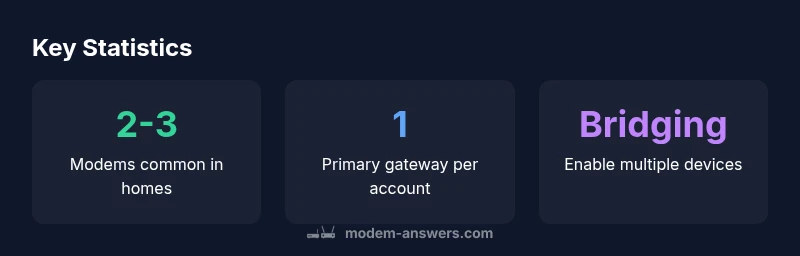
In small apartments, a single gateway is usually enough to deliver solid coverage and speed, but even there some users deploy an extra modem or access point for dead zones. For medium homes, two or three devices often deliver reliable connectivity across multiple floors, while larger homes may benefit from a carefully planned multi-modem setup with disciplined network zoning. Remember that the goal isn't just more devices; it's better coverage and predictable performance across the space you inhabit.
Network design considerations when using multiple modems
When deploying more than one modem or gateway, plan your IP addressing and DHCP strategy to avoid conflicts. Decide whether you want a single- or dual-NAT setup, and consider using bridge mode to prevent double NAT. Use separate SSIDs and VLANs if necessary to isolate traffic, and keep firmware updated on all devices. Finally, document each device in your account notes so you can troubleshoot quickly if issues arise.
Troubleshooting when you hit a limit or experience issues
If you reach your limit or notice inconsistent performance, start with a quick audit of connected devices and firmware versions. Remove unused devices, refresh the lease, and verify cable compatibility. If problems persist, contact Xfinity support to reconfirm your limit and explore options like bridging, device replacement, or plan adjustments. A clean, documented setup often prevents future bottlenecks and keeps your home network reliable.
Modem count scenarios by plan type
| Scenario | Modem Count Range | Notes |
|---|---|---|
| Residential plan (single gateway) | 1-1 | Standard setup |
| Residential plan (multi-modem) | 2-3 | Common for larger homes |
| Business plan or high-demand setup | 3-6 | Higher limits with business accounts |
FAQ
Does Xfinity publish a hard limit on the number of modems?
No public hard limit is published; limits vary by plan and region. Check My Account or contact support for your exact number.
Xfinity does not publish a single hard limit; it depends on your plan and location.
Can I use my own modem and add more than one?
You can use a compatible modem with Xfinity; you may add more devices if allowed and properly activated; bridging and activation steps apply.
Yes, you can use a compatible modem, and you might be able to add more devices with proper activation.
Will adding more modems slow down my internet?
More modems themselves do not automatically slow down; performance depends on plan bandwidth, network design, and traffic. Misconfiguration can cause issues.
More modems won't automatically slow you down; it depends on setup.
How do I request extra modems from Xfinity?
Contact Xfinity support or use the My Account chat to request additional units; they will advise on availability and activation steps.
Contact Xfinity support or use My Account to request extra modems.
What about business accounts or enterprise plans?
Business accounts often have higher limits; speak with a sales rep to determine equipment counts and activation.
Business plans typically allow more modems; talk to a rep.
“There isn't a universal public cap on the number of modems that can be used with Xfinity; limits depend on plan, region, and device compatibility. Always verify your exact limit in My Account or with support before adding devices.”
Key Takeaways
- Check your account to confirm the exact limit.
- Bridging can extend coverage but requires compatibility and activation.
- Limits vary by plan and region.
- Coordinate with support before adding modems to avoid service issues.
- Use the Xfinity app to monitor connected devices.