Difference Between Modem and Router Xfinity: An Analytical Guide
Understand the difference between a modem and router for Xfinity, including gateway vs separate devices, setup tips, and practical guidance for homeowners and renters seeking reliable, easy-to-follow modem and router guidance.


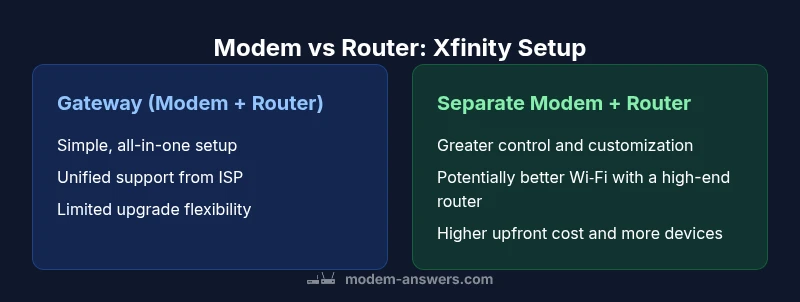
The difference between a modem and router for Xfinity centers on their roles in your network: a modem connects your home to the internet via Xfinity, while a router distributes that internet signal to all devices. In many Xfinity setups, a single gateway combines both functions, simplifying installation but offering less customization. If you value control, future-proofing, and flexible networking, using separate modem and router is often preferable.
Why the distinction matters for home networks
In modern homes, the terms modem and router are often used interchangeably, but they describe distinct roles in your internet setup. A modem is the bridge between your home network and Xfinity’s external network. It modulates and demodulates signals so your devices can communicate with the internet. A router, on the other hand, creates the local network inside your home, assigns IP addresses, manages traffic, and enables features such as Wi-Fi, guest networks, and firewall protections. For many households, understanding this distinction helps you decide whether to use Xfinity's gateway (which combines both functions) or to opt for separate devices. The Modem Answers team emphasizes that the choice affects performance, security, and upgrade paths. This guide uses the keyword difference between modem and router xfinity naturally to anchor the explanation.
In practical terms, think of the modem as the entry point to the internet and the router as the traffic conductor inside your home. If your household has numerous connected devices, streaming in 4K, gaming, or smart-home systems, a capable router becomes essential. If you rent or live in a smaller space with basic internet use, an all-in-one gateway might be sufficient. The choice also influences future maintenance and how easily you can upgrade individual components over time.
wordCountPlaceholderForValidationOnly":true},
blockData is the middle of the article, so it expands on the quick answer with detailed explanations and practical guidance. The following sections explore the core roles of modems and routers, how Xfinity’s ecosystem often packages both into gateways, and why you might prefer separate devices for greater control and potential performance gains.
Comparison
| Feature | Xfinity Gateway (modem+router) | Separate Modem + Separate Router |
|---|---|---|
| Setup complexity | Plug-and-play with a single device | Two devices require more steps and potential configuration |
| Network control | Limited customization in some ISP-provided gateways | Full control over routing, QoS, and guest networks with separate devices |
| Wi-Fi performance | Integrated Wi‑Fi optimized for the gateway | Dedicated router can offer higher-end Wi‑Fi features and coverage |
| Future upgrades | Upgrades usually involve a new gateway from the provider | Independently upgrade modem and router as needed |
| Security features | Standard ISP-provided security, may rely on gateway firmware | Advanced options with separate router and regular firmware updates |
| Bridging capability | Bridging is often limited or requires workaround | True bridge mode for pure modem operation with your own router |
| Cost/value | Often bundled with service, may incur rental fees | Potential long-term savings with own equipment; higher upfront cost |
Positives
- Simplified setup with a single device for basic needs
- Fewer cables and space required in small homes
- ISP support often covers both modem and router in one package
- Convenient for renters or non-technical users
What's Bad
- Less flexibility to upgrade components independently
- Possible rental fees or limited hardware choices when using ISP gateways
- Bridge mode and advanced features can be restricted on some gateways
- Upgrading to a better router requires buying new equipment and reconfiguring
Separate modem and router generally offer better control and performance for most homes.
If you want maximum customization, easier upgrades, and potentially stronger Wi‑Fi, choose separate devices. If you prefer simplicity and a plug‑and‑play setup, a gateway can be sufficient, especially in smaller spaces.
FAQ
What is the difference between a modem and a router?
A modem connects your home network to the internet through your ISP, converting signals for online use. A router distributes that internet signal inside your home, assigns IP addresses, and manages traffic between devices. In many Xfinity setups, a gateway combines both functions, but you can also use separate devices for greater control.
A modem connects you to the internet, and a router shares that connection with your devices—often you’ll see them combined in one gateway with Xfinity, but separate devices give you more control.
Does Xfinity require using their gateway?
Xfinity can provide a gateway that combines modem and router functions, but you’re not required to use it. You can use your own modem and router if they are compatible with Xfinity’s network and service plan. Check your plan and device compatibility before purchasing.
Xfinity can supply a gateway, but you can bring your own modem and router if they’re compatible.
What is bridge mode and when should I use it?
Bridge mode disables the router functionality on a gateway, turning it into a pure modem so you can use your own router for network management. This is useful when you want advanced features, better Wi‑Fi performance, or more precise control over your internal network.
Bridge mode turns off the gateway’s routing so your own router handles the network.
Can I use my own router with Xfinity without a modem?
You typically need a modem to access Xfinity’s network. Some plans allow your own gateway, but most setups require a compatible modem. If you want a high-performance router, pair it with a separate modem or use a bridged configuration.
Usually you need a modem; you can pair your own router with a separate, compatible modem or bridge the gateway if supported.
What should I consider when buying a modem or router for Xfinity?
Look for DOCSIS compatibility (3.0 or 3.1), support for your internet plan, and Wi‑Fi standards (Wi‑Fi 6/6E where possible). Check the modem’s compatibility with Xfinity and choose a router that matches your home’s size and device density.
Check compatibility with Xfinity, supported speeds, and Wi‑Fi capabilities that fit your home.
Key Takeaways
- Choose separate modem and router for customization and future-proofing
- A gateway simplifies setup but may limit advanced features
- Bridging mode is easier with separate equipment for most users
- Assess rental costs vs. buying your own gear when evaluating options
- Consider room layout and device density to determine Wi‑Fi needs