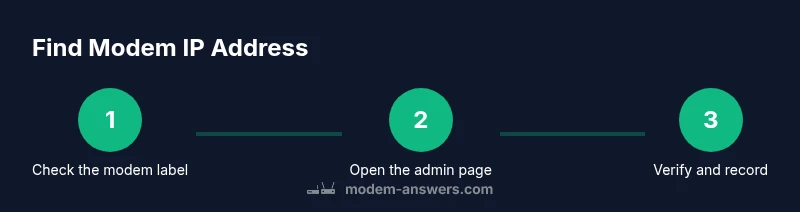
Where Is Modem IP Address: A Step-by-Step Finder
Learn where to find your modem IP address, why it matters, and step-by-step methods for Windows, macOS, iOS, and Android. This Modem Answers guide helps homeowners locate the gateway to the admin interface quickly.


Your modem IP address is the private gateway used by your home network to reach the modem's built-in management interface. It is not your public IP address on the internet, but the LAN address your devices use to talk to the modem itself. Knowing this address lets you access status pages, set up parental controls, configure port forwarding, and tweak security settings. According to Modem Answers, this IP acts as the central doorway to your home network's essential settings. If you need to troubleshoot connectivity or optimize your network, finding the modem IP address is the first step. In most homes, the number can be found on a label on the bottom or back of the modem, in the device's manual, or within the mobile app provided by the manufacturer. The actual value can vary by brand and model, but the process to locate it is the same: identify the gateway on the device or in your connected device's network settings, and, if needed, verify through the admin interface. This address should be kept private to prevent unauthorized access.
What is a modem IP address and why it matters
Your modem IP address is the private gateway used by your home network to reach the modem's built-in management interface. It is not your public IP address on the internet, but the LAN address your devices use to talk to the modem itself. Knowing this address lets you access status pages, set up parental controls, configure port forwarding, and tweak security settings. According to Modem Answers, this IP acts as the central doorway to your home network's essential settings. If you need to troubleshoot connectivity or optimize your network, finding the modem IP address is the first step. In most homes, the number can be found on a label on the bottom or back of the modem, in the device's manual, or within the mobile app provided by the manufacturer. The actual value can vary by brand and model, but the process to locate it is the same: identify the gateway on the device or in your connected device's network settings, and, if needed, verify through the admin interface. This address should be kept private to prevent unauthorized access.
How the modem IP address is used in everyday tasks
The modem IP address is more than a technical curiosity; it is the gateway to essential network management tasks. With access to the admin interface, you can view current device status, monitor connected clients, adjust wireless settings, enable firmware updates, and configure features like parental controls or port forwarding. Knowing the IP helps you diagnose why a smart home device isn’t reachable or why a firewall rule isn’t taking effect. The Modem Answers team emphasizes security: always sign out after making changes, and avoid leaving default passwords in place. By routinely verifying that you can reach the admin page after a reboot or after changes in the network, you reduce the chance of misconfigurations that could lock you out of the admin page. If you maintain a record of the IP alongside login credentials and firmware versions, you’ll have a clear map for future upgrades and troubleshooting. The result is faster recovery from outages and greater confidence in your home network’s behavior.
Common defaults and how addresses vary by brand
Many modems use a private LAN address in the 192.168.x.x family, with common defaults such as 192.168.0.1 or 192.168.1.1. Some providers rely on different subnets, such as 10.0.0.1, or assign an address dynamically via DHCP that changes after reboot. Because there is no single universal address, the best practice is to check the label on the device, consult the manual, or inspect the network settings on a connected computer or phone. If you have a separate router attached to your modem, the address you’ll see in the router’s settings might be different from the modem’s internal management IP. In all cases, ensure you’re looking at the IP used to reach the modem’s admin page, not the IP shown to the wider internet. Keeping this distinction clear prevents confusion during setup and troubleshooting.
Quick methods to locate the IP address (overview)
There are several reliable pathways to locate the modem IP address without guessing. First, look for a label on the modem itself that lists the default gateway, username, and password. Second, open the manufacturer’s mobile app and navigate to Status or Network settings to view the gateway. Third, check your computer or phone’s network settings: on Windows, macOS, iOS, or Android, the gateway or router IP is typically shown next to the active connection. Fourth, use a short command or built-in tool to reveal the gateway, such as ipconfig on Windows or ip route on Linux. Finally, if all else fails, reboot the modem and retest one of the above methods. This multi-path approach minimizes dead ends and adapts to provider-specific interfaces.
Troubleshooting when the address isn’t visible
If the modem IP address does not appear in the expected place, start with basic checks: ensure you’re connected to the modem’s network, and verify the device is powered on. Look again at the label and re-check the admin app. Some providers partition settings behind a separate bridge or guest network, which can hide the gateway from certain devices. Use Windows’ ipconfig or macOS’ Network utility to display the Default Gateway, which is typically the modem’s LAN IP. If you still cannot access the admin page after power cycling, consult your provider’s support portal or perform a safe reset to restore factory defaults, then re-check the label or app. Remember to back up essential settings before any reset and to reconfigure security after reboot.
Using the gateway to change or check security settings
Once you locate the IP address and log into the admin page, you can adjust important security and performance settings. Change the default admin password to a strong, unique credential and enable two-factor authentication if offered. Review firmware update status and apply the latest version to close vulnerabilities. Consider enabling a guest network to isolate IoT devices and set up a basic firewall rule to limit inbound threats. After making changes, exit properly and test that your devices can reconnect to the network. Document the new login details to maintain ongoing control over your home network.
Device-specific quick reference (Windows, macOS, iOS, Android)
- Windows: Open Command Prompt and type ipconfig; read the Default Gateway under your active network connection. The gateway is usually the modem’s LAN IP.
- macOS: Open System Preferences > Network > select your connection > Advanced > TCP/IP; look for Router. The value is the modem’s IP address.
- iOS: Go to Settings > Wi‑Fi > tap your network and view Router. The number shown is the modem’s IP when connected to the unit.
- Android: Settings > Network & Internet > Wi‑Fi > [your network] > Advanced > Gateway. If you don’t see it, use a third‑party network utility app.
Tip: If you use a separate router, verify you are looking at the modem’s IP, not the router’s LAN address.
Next steps and best practices
Keep your modem firmware up to date and backup configuration settings after locating the IP address. Note that some providers change the gateway address after factory resets or firmware updates, so verify again occasionally. Use strong, unique credentials for admin access, and avoid sharing login information. If you frequently adjust settings, create a quick-reference sheet with the IP address, username, and the latest firmware version. Finally, consider creating a simple note about where the device is located and how it’s powered, so future maintenance is quicker and less intimidating.
Tools & Materials
- Computer, smartphone, or tablet(Ensure the device can browse the web and is connected to the modem's network (Wi‑Fi or Ethernet).)
- Web browser(Chrome, Edge, Safari, or Firefox are all suitable.)
- Ethernet cable (optional)(A wired connection is more stable during setup.)
- Modem label or manual(Check the sticker on the modem for the default IP, username, and password.)
- Manufacturer app (optional)(Some models display the IP address in the app.)
- Notepad or digital note(Record IP, login, and firmware version after finding it.)
Steps
Estimated time: 15-25 minutes
- 1
Prepare your device and connection
Power on the modem and ensure your device is connected to the same network (Wi‑Fi or Ethernet). This baseline connection is essential for reaching the admin interface without errors.
Tip: A stable connection reduces load times and prevents partial pages from loading. - 2
Find the gateway address using the modem label or app
Inspect the bottom/back label for the default gateway IP. If your modem has a companion app, open it and navigate to Status or Network settings to view the gateway.
Tip: Labels may list multiple addresses; ensure you pick the one designated for the admin page. - 3
Try common default addresses in your browser
Open a browser and enter http://192.168.0.1 or http://192.168.1.1. If neither works, try 10.0.0.1 or re-check the label again.
Tip: Enter the address exactly as shown on the label; avoid typos that block access. - 4
Log in to the admin interface
If prompted, enter the username and password from the label or manual. If you’ve changed them before, use your current credentials. If you can’t recall, use the default password recovery method or reset the modem as a last resort.
Tip: Do not reuse passwords across sites. This login protects your network. - 5
Navigate to the IP address display
Go to the Status, Network, or LAN page to locate the IP address assigned to the modem on the LAN side. Different brands label this as ‘Router IP’, ‘LAN IP’, or ‘Gateway IP’.
Tip: If you have a separate router, verify you are viewing the modem’s IP, not the router’s address. - 6
Verify with a quick check
On Windows, run ipconfig in Command Prompt; on macOS/Linux, run ifconfig or ip route. The Default Gateway field is typically the modem’s IP.
Tip: Double-check you’re checking the correct device if you have multiple network interfaces. - 7
Record and secure the IP address
Jot down the IP address and, if appropriate, update the admin password. Keeping a record helps future maintenance and troubleshooting.
Tip: Store the information in a secure location and label it with the date of capture. - 8
Troubleshoot if you cannot access the page
Power cycle the modem, check cables, disable VPNs, and ensure local access isn’t blocked by a firewall. If problems persist, contact your provider’s support or perform a safe factory reset.
Tip: Always back up settings before a reset and reconfigure security after reboot.
FAQ
What is the difference between the modem IP address and my computer's IP address?
The modem IP address is the gateway to the modem's admin page on your local network. A computer's IP address is assigned for communication on your network. They serve different roles and are not interchangeable for admin access.
The modem IP address is your gateway to the modem's admin page, while your computer's IP is just its place on the network.
Why can't I find the modem IP address?
You might be connected to a different network, the modem could be in bridge mode, or the IP is displayed only in the admin app. Verify you’re on the correct device and try multiple methods listed in the guide.
If you don’t see it, check the app and the device label, and ensure you’re on the right network.
Can I change the modem IP address?
Yes, many modems let you customize the LAN IP range from the admin interface. Changing it may affect connectivity with connected devices, so proceed with caution and document the new value.
You can change it in the admin settings, but be careful to reconnect all devices afterward.
Is my IP address the same as my public IP address?
No. The modem IP address is a private LAN address used locally. Your public IP is assigned by your ISP and is visible to the internet.
Your private IP is for local use; your public IP is what websites see.
Can I find the IP address on mobile data?
No. You must be connected to the modem's network to view the local gateway. Mobile data networks do not expose your home device IPs.
You need to be connected to the home network to see the gateway address.
What if I forgot the admin password?
Use the provider’s password recovery or reset options from the admin page or label. If all else fails, a factory reset may be required, then reconfigure settings carefully.
If you forgot it, try recovery; a reset is a last resort.
Should I enable bridge mode or keep the router and modem separate?
Bridge mode turns off the modem's router functions and passes control to a separate router. This is common for advanced networks but requires reconfiguring the network to avoid conflicts.
Bridge mode can improve performance if you use a dedicated router, but it needs careful setup.
How often should I verify the modem IP address?
Check after any reboot, firmware update, or when you notice connectivity changes. Documenting changes helps prevent future access issues.
Check it after restarts or updates so you stay in control.
Watch Video
Key Takeaways
- Identify the modem IP from the device label or settings.
- Access the admin page from a connected device.
- Record and secure the IP address and login details.
- If needed, use the manufacturer app or manual for clarification.