Does a Modem Have an IP Address? A Practical Home-Network Guide
Learn whether a modem has an IP address, how it fits your home network, and step-by-step methods to locate and verify it. Clear guidance for homeowners and renters from Modem Answers.


Yes, a modem typically has an IP address on your local network, but how it’s used depends on your setup. If the modem functions as a gateway, it will have a management IP address you use to sign in. In many homes with a separate router, the router handles private IPs for devices, while the modem’s address is mainly for admin access and bridging when needed. If you’re curious about the exact address, does modem have ip address comes up often; log in to the modem’s admin page or run a quick network scan to identify the address.
What is an IP address in home networks
An IP address is a numeric label assigned to devices on a network, enabling them to communicate. In most residential setups, private IP addresses are issued by your home router using DHCP, typically in the 192.168.x.x or 10.x.x.x ranges. The public IP address, seen by websites and services on the internet, is assigned by your ISP and can change over time. For homeowners, understanding the distinction between private (LAN) IPs and the public IP helps with troubleshooting, device management, and security. According to Modem Answers, clarity about roles matters: your devices get private IPs from the gateway, while the ISP provides the public IP. If you’re evaluating whether to modify your network, keep in mind that the central piece is the gateway device rather than a standalone modem in most households. The simple question often asked is does modem have ip address, and the answer depends on whether the modem is in bridge mode or performing routing duties. In many consumer setups, the modem’s primary purpose is bridging the path to the router and the wider internet, not actively managing LAN devices, though it can participate in IP management when set up as a router.
tip
Tools & Materials
- Smartphone, tablet, or computer(Used to access admin pages or run a quick network check.)
- Web browser(Chrome, Edge, Safari, or Firefox work for entering the modem's admin URL.)
- Ethernet cable (optional)(A wired connection helps ensure stable access when checking IP settings.)
- Pen and notebook (optional)(Useful for recording IP addresses and settings you find.)
Steps
Estimated time: 20-40 minutes
- 1
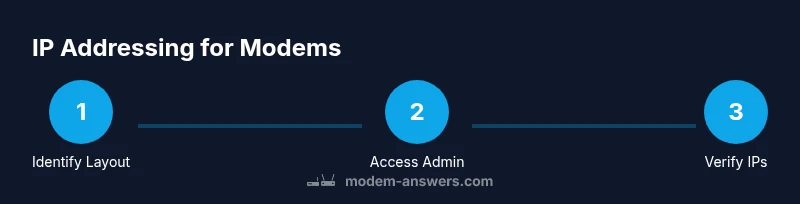
Identify your network layout
Begin by noting whether your home uses a separate router with a modem, or a gateway device that combines both functions. This determines where you’ll look for IP addresses. Understanding bridge mode versus router mode helps explain why the modem may or may not manage LAN IPs.
Tip: If you’re unsure, check the device labels for “Gateway” or “Bridge” mode indicators. - 2
Connect to the modem’s admin page
Open a web browser and enter the modem’s IP address, usually shown on a label on the device or in the manual. Sign in with the admin credentials. If you don’t know the login, try the default factory credentials commonly printed on the device.
Tip: If you’ve never changed the login, reset credentials securely and avoid using common defaults. - 3
Check the device’s IP settings
Navigate to the LAN or DHCP section to see the gateway IP, subnet, and DHCP range. This reveals whether the modem is issuing LAN IPs or simply routing traffic from a separate router.
Tip: Note the LAN IP shown for future reference and confirm whether the DHCP server is active. - 4
Run a quick network check from a client device
On a connected computer or phone, list the IP addresses of active devices. This confirms which IPs are in use and helps identify the router’s vs. modem’s address.
Tip: On Windows, open Command Prompt and run ipconfig /all; on macOS, use System Preferences > Network. - 5
Decide if you need bridge or router mode
If multiple devices are behind a single NAT and you want simpler IP management, bridging the modem may be appropriate. If you need all features in one device, keep it in router mode and confirm the IP address ranges.
Tip: Bridge mode often disables NAT; ensure you have a separate router to maintain local IP management. - 6
Document and verify
Record the identified IP addresses and the device roles in your home network. Re-test after any changes to ensure stable connectivity.
Tip: Keep a small network map for quick reference during future troubleshooting.
FAQ
Does every modem have a dedicated IP address?
Most home networks assign the modem a local management IP when it acts as a gateway. If the modem is in bridge mode, the LAN IP management is handled by the connected router instead. In either case, you can usually access admin settings through the modem or gateway interface.
Most modems have a local management IP, but in bridge mode, the router handles IPs.
What’s the difference between a modem IP and a router IP?
The modem IP is for management access to the device itself, while the router IPs are assigned to devices on the home network. In many setups, the router provides the private IPs to laptops, phones, and smart devices, not the modem.
Modem IP is for device management; router IPs are for your home devices.
How do I access my modem's admin page?
Find the modem’s local IP address from the label or manual, then enter it into a browser. Sign in with the admin credentials. If you’ve never changed them, refer to the device’s default login and secure it afterward.
Open a browser, enter the modem’s IP, and log in with credentials.
What if I can't find the IP address?
Try connected device lists in the admin page, run a quick network scan, or check your computer’s network settings. If needed, reset to factory defaults and reconfigure your network from scratch.
Check the admin page list or run a network scan; consider a factory reset as a last resort.
Can I change my modem's IP address?
Yes, you can usually change the modem’s LAN IP or switch modes in the admin interface. Do not disrupt critical addresses unless you understand DHCP ranges and gateway settings.
You can change the LAN IP in the admin area, but be careful with DHCP settings.
Watch Video
Key Takeaways
- Identify whether your modem is in gateway or bridge mode.
- Distinguish between private LAN IPs and the public IP from your ISP.
- Know how to locate the modem’s IP address quickly.
- Keep admin credentials secure and document network settings.