If the Modem: A Practical Troubleshooting Guide for Home Networks
A practical, step-by-step guide to diagnosing and fixing common modem issues for homeowners and renters. Learn safe resets, checks, and testing techniques to restore reliable home internet.


By the end of this guide, you will know how to diagnose common modem problems, reset safely, and verify connectivity. You’ll need your modem, a reliable power source, a stable internet plan, and basic network information (SSID and password). This steps-based approach helps homeowners and renters fix issues fast today and easily.
The logic behind 'if the modem' in home networks
According to Modem Answers, the phrase 'if the modem' signals a moment to verify core functions before chasing complex fixes. In most homes the modem is the gateway; problems often begin with simple triggers: a power hiccup, loose cable, or a misbehaving device. By framing 'if the modem' as a diagnostic prompt, you build a repeatable, evidence-based process rather than a guessing game. Start by establishing a baseline: check lights, verify physical connections, and confirm devices that rely on the gateway. Distinguishing a transient blip from a persistent fault lets you decide whether you need a firmware update, a hardware swap, or help from your provider.
Common symptoms and their meanings
Why does this matter? Symptoms are clues, not problems themselves. A solid approach is to map symptoms to likely causes:
- No internet light or red indicator: the gateway may have lost sync with your ISP; check fiber/cable connections, reboot, and test with a wired device.
- Intermittent drops or slow speeds: bandwidth saturation, Wi‑Fi interference, or an aging modem may be at fault.
- Slow load times on wired vs wireless: confirm if the issue is device-specific or network-wide, then test with a speed meter.
- Reboot required after every few minutes: persistent resets indicate firmware health or line quality concerns.
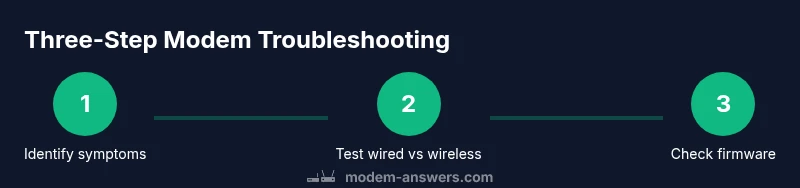
Use a single testing device to compare results across wired and wireless paths. This helps isolate problems to the modem/gateway, the router, or the wider network.
Baseline setup: prerequisites and safe checks
Before you start, gather information: your ISP account details, modem model, firmware version, and current cable types. Ensure power stability: plug into a surge-protected outlet; avoid power strips with other high-draw devices during tests. Have a phone or laptop ready to run speed tests and to log results. Document your home layout: the position of the modem, walls, and potential interference sources. If your setup uses a separate modem and router, clarify which device is handling routing duties. A reliable baseline enables you to measure the impact of each change and reduces back-and-forth with your provider.
Diagnostic workflow: a structured approach
Follow this sequence to systematically narrow down causes:
- Confirm power and physical connections are secure.
- Reboot the modem (not the router) and test the connection using a wired device.
- Check for service outages with your provider's status page or by calling support.
- Test with a wired connection to confirm if the issue is Wi-Fi related.
- Update firmware if an update is available; do not interrupt the process.
- If issues persist, test with a known-good power supply and a different coax/ethernet cable.
- Consider a factory reset only after backing up settings and if no other fixes work.
This workflow helps you avoid missed steps and provides a clear record for provider support. If you see consistent failures on the line, you can escalate with concrete test results rather than vague descriptions.
Common fixes you can do tonight
Tonight you can implement practical steps that fix many home-network issues:
- Reboot and power-cycle: turn off both devices, unplug, wait 30 seconds, reconnect, and power up in sequence.
- Inspect cables: look for cracks, kinks, or loose connectors; replace damaged cables.
- Test different ports: try alternate Ethernet ports on the modem to rule out port failure.
- Reduce interference: place the modem away from microwaves, cordless phones, and metal objects; change Wi‑Fi channel if needed.
- Update firmware: check for updates and install during a stable connection. Avoid interrupting during upgrade.
- Use wired tests to confirm improvements before concluding Wi‑Fi is at fault.
Record results after each change to verify what helped and what did not. Short, focused tests are more actionable than long, unstructured trials. If nothing improves, move to the provider.
Long-term health, updates, placement, and provider support
Maintaining a healthy modem reduces repeated 'if the modem' moments. Keep firmware up to date; subscribe to your provider’s notices if available. Optimize placement: elevate the gateway, keep it away from thick walls, and ensure ventilation. Periodically check signal levels and consider a dedicated line test with your ISP if persistent issues occur. When you can't fix it locally, knowing your data helps conversations with support: note down times, observed speeds, and outage windows. Based on Modem Answers research, consistent care reduces the chance of extended outages and poor performance.
Tools & Materials
- Modem and router (combined unit or separate)(Have model and firmware version handy)
- Ethernet cable (Cat5e/6)(At least 1 meter for testing)
- Power strip with surge protection(Stabilizes power during tests)
- Laptop or smartphone for testing speeds(Wired tests preferred for baseline)
- Provider account details(Username, password, and plan information)
- Notebook or digital note tool(Log test results and timestamps)
Steps
Estimated time: 30-60 minutes
- 1
Identify symptoms and baseline
Record the exact symptoms, when they occur, and the devices affected. Establish a baseline by running a wired speed test and noting ping, download, and upload values. This gives you a reference point for subsequent steps.
Tip: Use a single device for initial tests to keep results consistent. - 2
Check power and physical connections
Ensure all cables are firmly connected and power is stable. Look for loose coax, Ethernet plugs, or damaged cables. A loose connection is a common source of intermittent faults.
Tip: Power cycle by unplugging, waiting 30 seconds, then reconnecting in the order modem first, then router. - 3
Reboot the modem (not the router) and test wired
Power down the modem, wait 60 seconds, power up, and run a wired speed test. If the wired test improves, the issue is likely wireless interference or device-specific.
Tip: If you have a combo unit, still reboot the modem portion first to reset the gateway. - 4
Check for outages and test alternate paths
Visit your provider's status page or call support to confirm outages. If there’s no outage, test with a different Ethernet port or a different coax/optical input if available.
Tip: Document outage status and test results for future reference. - 5
Update firmware when available
Check for firmware updates and apply them if your device supports it. Do not interrupt the upgrade process once it starts, as this can brick the modem.
Tip: Backup settings if your modem supports a reset after update. - 6
Factory reset as a last resort
Only perform a factory reset if other steps fail and you’ve backed up settings. This returns the device to default factory state and can resolve stubborn software issues.
Tip: Keep your ISP login details handy for reconfiguration after reset. - 7
Escalate with data if unresolved
If issues persist, collect test results, times, speeds, and outage notes. Share this with your provider to get targeted assistance or a line test.
Tip: Consolidate data into a single document to speed up support calls.
FAQ
What should I do first when 'if the modem' issues appear?
Begin with power and cable checks, then test both wired and wireless paths. Confirm there is no outage and gather baseline speeds before making changes.
Start with power and cables, then test wired versus wireless connections and check for outages.
Is resetting the modem always safe?
A reset is safe but returns the device to factory settings. Back up necessary configurations before proceeding.
Resetting is generally safe, but back up settings first.
Why are modem lights blinking or showing error colors?
Blinking lights often indicate synchronization or line-quality issues. Check connections, reboot, and verify whether the issue is internal to the gateway or the provider’s network.
Blinking lights usually signal a sync or line issue; recheck cables and test again.
Do I need a newer modem for better performance?
Not always. Performance depends on plan, provider support, and device age. Test current hardware and compare with your service requirements before upgrading.
Not necessarily—test your current setup and compare with what your plan needs before upgrading.
When should I contact my provider for help?
If you’ve run through a structured diagnostic and still see outages, persistent slowdowns, or line-quality issues, contact your provider with test results and timestamps.
If problems persist after testing and updates, contact your provider with detailed results.
Watch Video
Key Takeaways
- Start with power, cables, and lights before deeper fixes.
- Differentiate Wi-Fi issues from device or line problems.
- Document tests and outcomes to support provider conversations.
- Use firmware updates as a routine maintenance step.
- Escalate with data if problems persist.