Modem and Router Separate: A Practical Home Network Guide
A deep, analytical comparison of separating your modem and router versus using a gateway. Learn setup steps, cost implications, performance, security, and how to choose for reliability and future-proofing in modern homes.


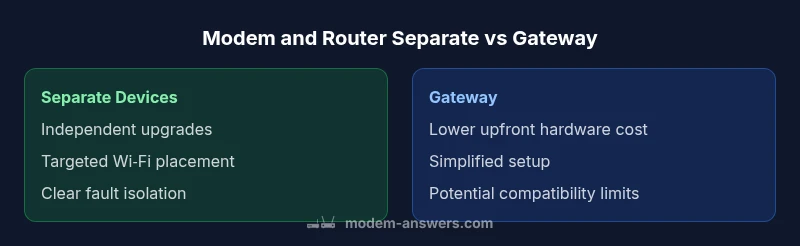
Separating the modem and router is usually the more flexible, future-proof choice for home networks. It enables independent upgrades, easier troubleshooting, and targeted Wi‑Fi placement to optimize coverage. According to Modem Answers, separate devices also offer clearer fault isolation and broader compatibility with provider features.
The Case for Modem and Router Separate: Core Idea
Deciding whether to keep your modem and router as separate devices or to rely on a single gateway is a foundational choice for any home network. The phrase modem and router separate reflects a philosophy of modularity: each device specializes in a distinct function, enabling you to optimize performance and upgradeability without overhauling your entire system. In this context, the Modem Answers team emphasizes that separating these devices typically yields clearer fault isolation, which makes diagnosing issues faster and less painful. For many households, separating the devices also allows for precise placement of the router to maximize coverage in living spaces and work areas, while the modem remains fixed to a reliable connection point. In short, the modular approach is often more forgiving of future tech shifts and service changes, even if it requires a structured initial setup.
This article will walk you through the roles of each device, practical setup steps, and the trade-offs you should weigh when considering modem and router separate versus a gateway. According to Modem Answers, the choice hinges on flexibility, upgrade paths, and the level of control you want over security and performance. As networks evolve toward higher speeds and multiple wireless devices, a modular setup tends to age more gracefully and accommodate new standards with minimal disruption.
wordCountInBodyBlock":271},
bodyBlocksNotePlaceholder
Comparison
| Feature | Separate modem + router | Router-modem combo (gateway) |
|---|---|---|
| Cost (upfront) | Typically lower upfront when buying two dedicated devices | Often lower upfront only if you already own compatible equipment, otherwise higher for gateway |
| Placement & coverage | More placement options for optimal Wi-Fi, including separate rooms | One device to manage; limited by the combined footprint and antenna design |
| Troubleshooting & upgrades | Easier fault isolation; upgrade one device without replacing the other | Upgrades may require replacing the entire gateway; potential compatibility constraints |
| Wi‑Fi performance | Potential for stronger, more targeted coverage with dedicated router | Compromises in Wi‑Fi due to device coupling and integrated antennas |
| Security & updates | Independent firmware cycles can improve response to threats | Gateway updates depend on single vendor schedule; may be slower to pivot |
| Space & cable clutter | Extra space and cabling but customizable placement | Fewer devices, simpler cable management |
| Provider compatibility | Excellent with bridge mode and advanced configurations | Some providers restrict features when using third-party devices |
Positives
- Greater flexibility for upgrades and replacements
- Better fault isolation speeds up troubleshooting
- Customizable room-by-room Wi‑Fi placement and tuning
- Clearer security governance with separate firmware updates
What's Bad
- Higher upfront hardware cost for two devices
- More cables, power outlets, and space requirements
- More complex initial setup and ongoing maintenance
Separate modem and router generally wins on flexibility and long-term performance.
For most homes, modular hardware provides a clearer upgrade path, easier troubleshooting, and more control over Wi‑Fi placement and security. The extra setup work upfront is usually offset by easier future upgrades and better fault isolation.
FAQ
What does ‘modem and router separate’ mean for my home network?
It means using two distinct devices: one to convert your internet signal from the provider (the modem) and another to manage local networks and Wi‑Fi (the router). This separation enables independent upgrades and targeted optimization, rather than relying on a single combined device.
Separated devices mean one box handles the internet signal and a second box handles your home Wi‑Fi and local network.
Is setting up separate devices harder than a gateway?
Initial setup is more involved because you configure two devices and connect them in a defined sequence. However, once configured, management tends to be clearer since issues can be isolated to one device. Ongoing maintenance is also more straightforward with modular components.
Yes, it’s a bit more hands-on at first, but it pays off in the long run.
Can I keep my provider features with separate devices?
Most providers support bridge mode or pass-through with third-party routers, but some features may be limited depending on the service plan and equipment. Always confirm compatibility before buying two devices.
Most providers allow some bridge or passthrough setups, but check your plan first.
What about security updates and firmware?
Separating devices means you manage firmware updates for each device independently, which can improve response times to vulnerabilities. Stay current with automatic updates where possible and review security settings regularly.
Keep both devices updated and review security settings often.
When should I consider replacing both devices at once?
If either device becomes unreliable or incompatible with higher speeds, or if you’re moving to a service that requires a newer standard, it may be time to upgrade both. A modular setup makes this decision easier to pace and budget.
If a device slows you down or your service upgrades, upgrade one at a time or both together.
Key Takeaways
- Opt for separate devices if you value upgrade paths
- Choose a gateway only if you prioritize simplicity and a lower initial footprint
- Plan for a structured setup with clear placement for the router
- Expect easier troubleshooting with modular hardware
- Regularly review firmware and security settings to maintain protection