Difference Router and Modem: A Side-by-Side Guide
A practical, objective comparison of modem vs router, detailing separate devices vs combined modem-router setups, with setup tips, performance considerations, and buying guidance for 2026.


The difference router and modem matters because a modem connects your home to your internet service, while a router creates the local network and Wi‑Fi that devices use to talk to each other. Understanding this difference helps homeowners decide whether to buy separate devices or a combined modem-router, and it informs setup, performance, and security choices. According to Modem Answers, getting this right from the start saves time and reduces frustration.
What Each Device Does: Modem Fundamentals
In a home network, two devices perform different, complementary roles. The modem is the bridge between your home and the internet service provider; it modulates signals from the telephone line, coaxial cable, fiber, or wireless link into data your devices can use. The router, by contrast, takes that data and distributes it inside your home, creating a local network and, most importantly, wireless access to smartphones, laptops, smart TVs, and IoT devices. The phrase difference router and modem becomes evident when you look at how each device handles traffic: the modem handles wide-area network communication with the ISP, while the router handles local-area network routing, address assignment, and traffic management. When you combine these roles in a single device, you get a gateway or modem-router, a common option for many households. For more complex homes or professional spaces, using separate devices can improve performance and customization options. Throughout this section, the keyword difference router and modem appears to anchor the explanation and ensure alignment with user intent.
Router Fundamentals: Creating Local Networks and Wi-Fi
A router's core job is to build and manage your home's local network. It assigns local IP addresses, routes traffic between devices, and provides firewall protections at the network edge. Most home routers extend that core function with Wi-Fi radios, enabling wireless connectivity. When evaluating the difference router and modem, the router is the moving part inside your home, translating internet data into usable packets across your devices. Look for features like dual-band or tri-band Wi‑Fi, support for multiple SSIDs, guest networks, and quality-of-service (QoS) controls that prioritize critical traffic such as video calls or gaming. Another important capability is Ethernet ports for wired devices; wired connections are generally more stable and faster than wireless. If you frequently run smart devices in the garage or far corners of your home, consider mesh networking to extend coverage. In many households, the router also handles security updates and the configuration interface. The aim is simplicity paired with reliability, balanced against the size and shape of your home network.
The difference router and modem: Core roles
Understanding how these devices share the data path clarifies what to buy and how to set up. The modem is the gateway to the internet; the router is the traffic director. The difference router and modem also matters for performance: if the modem's signal quality is weak or the router is outdated, your whole network will feel sluggish. In smaller apartments, a single combined device may suffice; in larger homes, separate devices often deliver more consistent speeds and easier upgrades. Modem Answers emphasizes evaluating both devices against your internet plan's speed, your home layout, and the number of connected devices. The practical takeaway is to map your coverage needs first, then select the device(s) that meet those needs without overpaying.
How They Interact: Bridging and Gateways
The interaction between modem and router is a critical junction for performance and security. In a typical home setup, the modem provides the public IP address, while the router uses network address translation (NAT) to assign private IPs to devices. In some configurations you may enable bridge mode on the router or use a dedicated firewall. The key concept in the difference router and modem is that the router manages traffic within your local network and to the internet, while the modem handles the connection to the ISP. If you use a combo device, these roles are pre-integrated, which can simplify diagnostics but may limit fine-tuning. The decision hinges on how much control you want over DHCP settings, port forwarding, and parental controls.
Common Deployment Scenarios: Separate vs Combined Devices
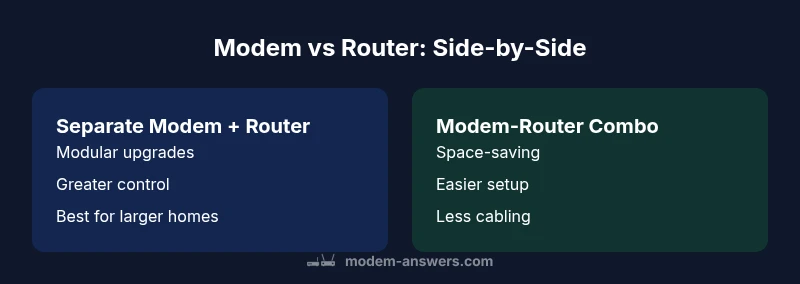
Two popular deployment paths illustrate the difference router and modem in practice. The first is a two-device setup: a standalone modem connected to the ISP line, with a separate router creating the home network. The second is a single, combined device often marketed as a gateway or modem-router. The two-device approach offers modular upgrades, better heat management, and greater customization, especially in larger homes or edge-case use cases like gaming rooms with high traffic. The single-device option minimizes clutter and simplifies setup, which can be attractive for small apartments or renters who prioritize convenience. By weighing these factors against your space, budget, and internet plan, you can decide which path aligns with your household’s needs. The difference router and modem should guide your expectations about future upgrades and maintenance.
Practical Buying Considerations: Speed, Features, and Compatibility
Choosing between separate devices and a combo unit means balancing speed, feature sets, and compatibility with your internet plan. Look for a modem that supports your ISP’s technology (DOCSIS for cable, fiber ONT compatibility, etc.) and a router with robust Wi-Fi standards, security updates, and QoS controls. The difference router and modem becomes a practical lens for evaluation: separate devices can yield stronger customization and longer upgrade paths, while a combo unit may save space and simplify onboarding. Consider future-proofing: check the maximum supported speeds, whether the router supports Wi‑Fi 6 or Wi‑Fi 6E, and how easy it is to update firmware. If your home expands or you add smart devices, modular components can adapt more readily than a single integrated unit. Modem Answers’ guidance stresses aligning hardware choices with your real-world usage patterns and your ISP’s speed tier to avoid bottlenecks.
Troubleshooting and Security Considerations
Troubleshooting in a mixed setup (modem and router) is typically easier because you can isolate problems to the device responsible for the network edge or to the internal network. Ensure you keep firmware up to date on both devices to close security gaps and improve performance. The difference router and modem is most evident when diagnosing whether an issue is caused by the modem’s connection to the ISP or by the router’s handling of internal traffic. Implement strong passwords, enable WPA3 on the router, and use guest networks to protect your primary devices. Regularly review connected-device lists and monitor for unusual traffic. If you rely on IoT devices, segment them on a separate VLAN or guest network to minimize attack surfaces. For most households, a regular reboot and a firmware check will fix a surprising number of problems.
Myths and Misconceptions Debunked
A prevalent myth is that every modem-router combo is equally capable for gaming or streaming. In reality, performance depends on the router’s CPU, RAM, and Wi‑Fi radio quality, not just the brand. Another common misunderstanding is that more LEDs on a router equate to better performance; indicators relate to status, not throughput. The difference router and modem concept often leads people to believe that a single device can meet all needs, but truly high-demand households benefit from separate devices or more capable mesh systems. Finally, some assume that firmware updates automatically occur; many devices require manual checks or reboots to complete updates. Debunking these myths helps homeowners make smarter, more durable investments.
Case Studies: Real-World Scenarios
Case Study A: A family with multiple 4K TVs, tablets, and remote-work laptops in a two-story home found that a separate modem and router delivered stronger, more consistent performance than their previous gateway. They added a mesh system for coverage in the far rooms and used QoS to prioritize video calls. Case Study B: An apartment dweller with a small budget and limited space opted for a single, modern modem-router, appreciating the simplicity and compact footprint. Case Study C: A tech enthusiast running a home office and a home lab valued upgradeability; they maintained separate devices and swapped in a high-end router while keeping a reliable modem. The difference router and modem perspective helps interpret these outcomes and tailor setups to the home’s layout and usage patterns.
Steps to Audit Your Home Network Today
Start with a quick inventory: what devices exist, how they connect, and which devices handle routing vs. ISP connection. Map coverage with a basic speed test in different rooms and note where signals fade. If you’re shopping, set a target speed based on your plan and measure current hardware against that benchmark. Evaluate security: confirm default passwords were changed, update firmware, and verify that your firewall rules are active. Consider future needs—will you add devices, require gaming performance, or expand to a larger property? Finally, decide whether you need modularity (separate modem and router) or simplicity (a modern combo device). This audit helps reveal whether your current setup aligns with the difference router and modem concept and where upgrades will matter most.
Authority Sources
For readers seeking external references, the following authoritative sources provide guidance on modem and router considerations and standards:
- https://www.fcc.gov/
- https://www.ntia.gov/
- https://www.nist.gov/
Comparison
| Feature | separate modem + router | modem-router combo |
|---|---|---|
| Setup complexity | Higher, needs coax/cable and separate configuration | Lower, plug-and-play with one device |
| Space and cabling | More space and cables | Less space, single cable |
| Upgrade flexibility | Easier to upgrade components independently | Upgrades limited to one unit |
| Cost range | Moderate to high initial cost (two devices) | Lower upfront cost for a single unit |
| Performance potential | Higher ceiling for advanced features and optimization | Adequate for many homes but may cap at some speeds |
| Security controls | Granular control with separate devices | Integrated controls may be convenient but less granular |
Positives
- Better performance in large or demanding homes
- Easier upgrades and troubleshooting
- Greater control over network features
- Flexible placement and cooling for each device
- Stronger security segmentation with separate devices
What's Bad
- Higher upfront cost and more clutter
- More complex setup and maintenance
- Two devices mean more cables and power use
- Potential compatibility considerations with ISP
Separate modem and router generally offer the best balance of performance and flexibility
If you prioritise long-term performance, customization, and easier troubleshooting, choose separate devices. A modem-router combo remains attractive for small spaces or straightforward setups, but it can limit future upgrades and granular control. The Modem Answers team emphasizes aligning your choice with home size, usage patterns, and the ISP speed tier.
FAQ
What is the primary function of a modem?
A modem connects your home network to your internet service provider, converting signals from the ISP into data your devices can use. It is the gateway to the internet, not the local network itself.
A modem links your home to the internet.
What is the primary function of a router?
A router creates and manages your local network, assigns IP addresses, and directs traffic between devices in your home. It also typically provides Wi‑Fi access for wireless devices.
A router builds your home network and handles traffic inside it.
Do I need a router if I have a modem?
Yes. Even if you have a separate modem, you’ll need a router to create a home network and share internet access among devices. If you buy a combo device, the router is included in the same unit.
You usually want both; a modem alone can’t distribute Wi‑Fi.
When should I choose separate devices over a combo?
Choose separate devices when you want better performance, easier upgrades, and more control over security and features. A combo is fine for small spaces or minimal setup needs.
Separate devices help if you want more control and future-proofing.
How do I know if my home needs a mesh system?
A mesh system is helpful if you have multiple floors or large areas with weak signal. It can provide uniform coverage where a single router struggles.
If your Wi‑Fi drops in far corners, consider mesh.
How often should I update firmware on these devices?
Regular firmware updates improve security and performance. Check for updates every few months and install them as soon as they’re available.
Keep firmware current to stay secure and fast.
Key Takeaways
- Choose separate modem and router for larger homes or advanced features
- Consider a modem-router combo for simple, compact setups
- Evaluate your ISP plan before buying to prevent bottlenecks
- Upgrade paths are easier with modular devices
- Secure each device with updated firmware and strong passwords