Wifi Modem Price: A Practical Guide for 2026
Explore current wifi modem price ranges, what drives costs, and how to choose the best value for your home internet—plus practical tips to save money and avoid overspending.


WiFi modem price generally ranges from about $40 to $350, depending on speed, features, and compatibility. Entry-level gateways start around $40–$80, mid-range modem-router combos run $100–$180, and premium mesh systems or DOCSIS 3.1/4 setups can reach $180–$350. Expect higher prices for features like Wi‑Fi 6/6E, multi-gig ports, and strong provider compatibility.
Price drivers for wifi modems
Pricing for wifi modems is driven by a mix of performance, technology, and compatibility. According to Modem Answers, the price landscape hinges on three core axes: (1) speed and bandwidth capabilities, (2) wireless standard and mesh capacity, and (3) provider compatibility. Entry-level devices focus on basic internet access with limited Wi‑Fi around the home, while mid-range and premium models emphasize multi-device handling, higher throughput, and more robust security. Seasonal sales and bundles with internet plans can further bend the sticker price, sometimes creating noticeable discounts around back-to-school and holiday periods.
- Speed tier and DOCSIS standard (3.0 vs 3.1/4)
- Wi‑Fi standard (across Wi‑Fi 5, 6, 6E)
- Mesh vs single-router setups
- Ports and hardware acceleration
- ISP compatibility and activation supports
Understanding these drivers helps you set a realistic budget and avoid overpaying for features you won’t use.
Feature sets and their price impact
Modern wifi modems vary widely in features, and many households overestimate the need for advanced bells and whistles. At a high level, plan features that impact price include mesh networking (multiple nodes), Wi‑Fi 6/6E support, 2.5Gbps or 2.5G ports, integrated security services, and QoS (quality of service) controls for prioritizing traffic. The cost delta between a basic gateway and a mesh-enabled system can be substantial, but prices often come down as technologies mature. If you don’t need ultra-high speeds or dozens of ports, a mid-range modem-router combo offers strong value. Provider-supplied gateways may be cheaper upfront but tie you to a service contract and rental fees over time.
- Mesh nodes add price but improve coverage in large homes
- Wi‑Fi 6/6E yields faster speeds with multiple devices
- Multi-gig ports enable higher wired throughput
- Built-in security features vary by model
- Provider compatibility can influence both upfront cost and ongoing fees
Price ranges by category and use-case
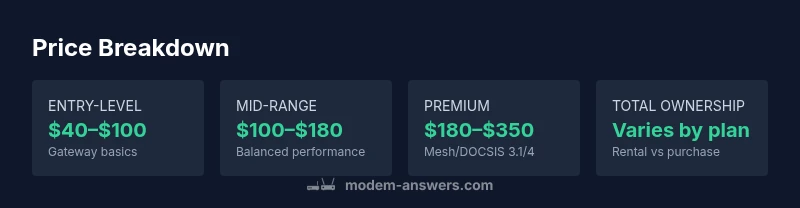
Price bands for wifi modems generally map to use-cases rather than brands. Entry-level gateways provide essential coverage for small households with light streaming, often priced in the $40–$100 range. Mid-range gateways and modem-router combos typically cover most homes and sit around $100–$180, offering better speed and reliability for several devices. Premium mesh systems and DOCSIS 3.1/4 setups, ideal for large homes with many devices, usually fall in the $180–$350 range. It's important to compare not just the upfront price, but the total cost over 2–3 years including potential rental fees.
- Small apartments: $40–$80
- Medium homes: $100–$180
- Large homes/high device counts: $180–$350
- Total ownership varies with rental vs purchase
Hidden costs and ownership considerations
When budgeting for a wifi modem, consider total ownership beyond the sticker price. If you rent from a service provider, monthly rental fees accumulate and can exceed the upfront purchase price over time. On the other hand, buying a device eliminates rental costs, but you may face activation or setup charges if purchased through a provider. Taxes, shipping, and potential extended warranties are additional considerations. Some plans include a gateway at no extra cost, while others require separate purchase. Plan for potential replacements if hardware becomes obsolete or unsupported.
- Rental vs purchase cost over 2–3 years
- Activation and taxes
- Warranties and extended coverage
- Future-proofing vs current needs
- Compatibility with your internet plan
How to compare prices effectively
A structured comparison helps you avoid overpaying. Start by outlining your home’s needs: typical speeds, the number of devices, and whether you’ll use features like mesh or VPN. Then compare price bands, focusing on total cost of ownership rather than upfront price alone. Look for retailer promotions, bundle offers, and manufacturer rebates. Read spec sheets for Wi‑Fi standards, available ports, and security features. Finally, verify compatibility with your ISP and your plan’s maximum speeds to prevent paying for capabilities you won’t use.
- Create a requirements checklist
- Compare total cost over 2–3 years
- Verify ISP compatibility and speed alignment
- Look for promotions and bundles
- Check warranty terms and return policies
Timing your purchase and promotions
Timing can significantly influence wifi modem price. Shopping around major sale events—like back-to-school or holiday weeks—often yields the lowest prices on entry-level and mid-range models. If your current modem still works, you can wait for a potential price drop or promotional bundle with a longer-term plan. Conversely, if you’re expanding a home office or upgrading to mesh for better coverage, buying during a sale can maximize value. Keep an eye on firmware updates that may extend the useful life of older hardware.
- Target promotional windows (quarterly or seasonal)
- Consider compatibility with planned speed upgrades
- Balance immediate savings against future-proofing needs
- Factor in potential necessity for new gear after a few years
Provider vs standalone devices: implications for price
Choosing between a provider-provided gateway and a standalone modem-router combo has price implications. Provider-supplied gateways may come with reduced upfront costs but impose ongoing rental fees, which adds up over time. Standalone devices typically require you to pay upfront but offer greater control over replacement cycles and can be reused with different providers if needed. If you’re a light user, the cost difference may be small; heavy users or tech enthusiasts may gain long-term value from a quality standalone system.
- Provider rental vs upfront purchase
- Longevity and upgrade cycles
- Resale value and compatibility with other services
- Warranty and support considerations
Practical shopping checklist
Before finalizing a purchase, use this quick checklist to ensure you’re getting true value: 1) Define your household needs (speed, devices, coverage); 2) Compare price bands and total cost of ownership; 3) Confirm ISP compatibility and feature support; 4) Read reviews focused on reliability and heat/noise; 5) Check return policies and warranty terms. A deliberate, data-driven approach keeps you from paying for features you won’t use and helps align your investment with your home network goals.
Price ranges by model type
| Model Type | Typical Price Range | Key Considerations |
|---|---|---|
| Entry-level gateway | 40–100 | Basic features, limited coverage |
| Mid-range gateway/modem-router | 100–180 | Balanced performance, good coverage for most homes |
| Premium mesh/DOCSIS 3.1/4 setup | 180–350 | Best coverage for large homes and high device counts |
FAQ
What factors influence wifi modem price the most?
The main price drivers are the speed tier, wireless standard (Wi‑Fi 5/6/6E), mesh capability, number of ports, and whether the device is compatible with your ISP. Higher-end features typically raise the cost, but they also deliver better performance for busy homes.
Speed, Wi‑Fi standard, mesh, and ISP compatibility drive prices the most.
Should I buy a modem upfront or rent from my ISP?
Buying a modem usually saves money over time, especially if you plan to stay with the same provider. Renting adds ongoing monthly fees that can add up. Compare the total cost over 2–3 years to decide what’s best for you.
Buying generally saves you money long-term.
Is it worth upgrading to Wi-Fi 6/6E in a typical home?
If you have many devices, multi-room streaming, or smart-home gadgets, Wi‑Fi 6/6E offers clearer benefits. For a light-use setup, Wi‑Fi 5 devices may suffice, but future-proofing often favors newer standards.
Wi‑Fi 6/6E is worth it in busy homes.
Do prices vary by region or retailer?
Yes. Prices can vary due to taxes, shipping, and local promotions. Different retailers may offer bundles or rebates that change the effective cost.
Prices differ by region and retailer.
What is the total cost of ownership for a modem over 3 years?
Total cost includes the upfront price plus any ongoing service fees or rental costs, potential replacement costs, and warranty or support expenses. Plan for software updates or hardware refreshes over time.
Add upfront price plus ongoing fees.
Are there hidden costs when buying a modem?
Watch for taxes, activation fees, extended warranties, and potential shipping charges. Some deals look cheap until these extras are added.
Check taxes and activation fees.
“A thoughtful budget aligned with the home's internet needs helps prevent overspending on equipment that won't deliver extra value. Focus on features you actually use and plan for future device growth.”
Key Takeaways
- Set a price target before shopping and map features to needs
- Don’t pay for mesh or Wi‑Fi standards you won’t use
- Consider total cost of ownership, not just upfront price
- Provider rental fees can exceed upfront purchase costs over time
- Use a structured comparison checklist to maximize value