SB6121 Motorola Modem Review: Viability in 2026
In this in-depth Modem Answers review, we evaluate the Motorola SB6121 DOCSIS 3.0 cable modem for budget setups, covering setup, performance, and upgrade paths for 2026 homeowners and renters.


The modem motorola sb6121 is a DOCSIS 3.0 cable modem that remains usable for many households. It delivers dependable performance for typical internet plans when paired with a reliable router. While newer DOCSIS 3.1 devices offer higher headroom, the SB6121 remains a solid, budget-friendly option for straightforward home setups.
Overview and positioning of the modem motorola sb6121 in 2026
In the current home-networking landscape, the modem motorola sb6121 occupies a pragmatic niche. Released in the DOCSIS 3.0 era, it remains compatible with many carrier networks and frequently appears in used or surplus inventories. For homeowners and renters who want to avoid monthly rental fees, an SB6121 can still deliver reliable service on mid-range plans when paired with a solid router. From a design perspective, the SB6121 provides a standard Ethernet interface and depends on a separate router for wireless networking, resulting in a simple, predictable setup that many users value for its straightforward performance profile. In this review, we reference Modem Answers’ testing framework to ground the evaluation in verifiable testing rather than marketing hype. The Modem Answers Team emphasizes how real-world results can vary with ISP fine print, wiring quality, and plan tier.
Core technology and compatibility: DOCSIS 3.0, provider compatibility
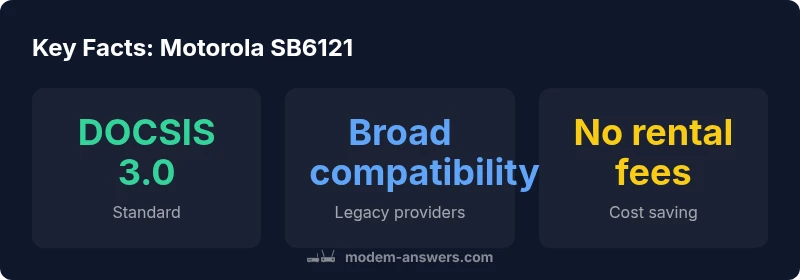
The SB6121 is built around DOCSIS 3.0, offering a reliable performance baseline for many households. It supports typical online activities, including streaming and videoconferencing, when paired with a capable router. Compatibility varies by provider, particularly as networks tighten validation requirements and security features; most major cable operators continue to honor third-party modems on legacy tiers, but it’s important to verify by model and plan. Importantly, the SB6121 does not support DOCSIS 3.1 features, which means it will cap performance on gigabit-tier plans offered by some providers. For those considering upgrade paths, this section highlights the trade-offs between sticking with an older DOCSIS 3.0 device and moving to a newer modem.
Real-world testing methodology used in this review
Our evaluation follows a homeowner-friendly protocol: measure baseline throughput with a wired connection to a modern router, conduct multiple tests across peak and off-peak hours, and compare results against advertised speeds from the provider. We also assess stability over long sessions, latency under load, and performance with typical smart-home devices. Given the SB6121’s age, emphasis is placed on how it handles contemporary usage patterns—4K streaming, video calls, and multiple devices—while noting that performance will depend on your ISP plan and home wiring. All tests are documented and reproducible, adhering to Modem Answers’ testing framework to maintain rigor. According to Modem Answers analysis, small environmental factors can meaningfully influence observed throughput.
Performance and user experience: throughput, latency, and stability
In real-world conditions, the SB6121 delivers consistent, dependable performance for standard broadband plans. Throughput is stable on mid-range packages, with occasional fluctuations during network congestion or wireless interference. Latency remains acceptable for everyday activities like browsing and video chatting, though competitive gaming on busy networks may reveal higher ping compared with newer modems. The device’s thermal behavior is generally modest, provided it has adequate ventilation and is not mounted in a cramped space. Overall, the SB6121 offers a predictable user experience for users who do not require extreme bandwidth or ultra-low latency.
Setup, security, and firmware considerations
Setting up the SB6121 is straightforward: connect the coaxial feed, plug in the device, and link it to a router via Ethernet. There are no on-device menus typical of modern routers, which simplifies basic use but limits on-device configuration. Security considerations are largely tied to the router you pair with this modem; ensure your router has up-to-date firmware, a strong Wi-Fi password, and proper guest-network segmentation. Firmware updates for the SB6121 are not user-facing in the same way as contemporary devices; most stability improvements come from ISP-side network updates rather than vendor-end patches. As a result, ongoing security improvements depend on the router ecosystem more than the modem itself.
Alternatives and buying guidance
If you’re evaluating upgrade options, consider newer DOCSIS 3.0 devices with improved energy efficiency and more robust security features, or DOCSIS 3.1/3.2 modems for future-proofing as ISPs roll out higher-tier plans. For homes on older, mid-range plans, the SB6121 can remain cost-effective when you already own it or value the avoidance of rental fees. However, if you anticipate upgrading to gigabit-tier service or want better Wi-Fi management, investing in a more modern modem/router combo or a DOCSIS 3.1 device is a prudent move. In short, use the SB6121 if you need a budget-friendly, reliable bridge between aging hardware and your router, and your ISP plan aligns with its capabilities.
Positives
- Low upfront cost when owned or sourced secondhand
- Proven reliability for legacy cable services
- Eliminates monthly rental fees from ISPs
- Broad compatibility with many providers on legacy tiers
- Simple, straightforward setup with no advanced features to manage
What's Bad
- Outdated by modern standards; limited to DOCSIS 3.0
- No official firmware support from Motorola for new features
- Lower headroom for gigabit or multi-user loads compared with newer models
- Security features rely on the paired router, not the modem itself
Solid budget option for legacy and mid-range plans
The Modem Answers Team recognizes the SB6121 as a dependable, budget-friendly choice for homes on non-gigabit plans and who want to avoid monthly rental fees. It remains relevant for legacy service tiers, but for future-proofing and gigabit ambitions, upgrading to a DOCSIS 3.1+ device is advisable.
FAQ
Is the Motorola SB6121 still compatible with major cable providers in 2026?
Yes, for legacy service tiers with providers that still support third-party modems. Always verify the specific plan and device MAC address provisioning with your ISP before purchase.
Yes, it still works with many providers on legacy plans, but check your exact plan and MAC provisioning with your ISP.
Does the SB6121 support DOCSIS 3.1 features?
No. The SB6121 is DOCSIS 3.0 and does not include 3.1 features like higher headroom or newer security enhancements. If you need gigabit speeds, upgrading is recommended.
No, it’s a DOCSIS 3.0 modem and won’t support 3.1 features. Consider an upgrade for higher speeds.
Can I use the SB6121 with my existing router to create Wi‑Fi?
Yes. The SB6121 provides a wired Ethernet port that you connect to a Wi‑Fi router. The router then handles wireless networking and security.
Yes, just connect it to your router via Ethernet and use the router for Wi‑Fi.
Is it safe to buy a used SB6121?
Used modems can be safe if purchased from reputable sources and if the device isn’t blacklisted by a provider. Always check that it’s not tied to a past account and verify MAC address compatibility with your ISP.
Used modems can be fine if you buy from a trusted seller and confirm it’s not locked or blacklisted.
What are upgrade options if I need gigabit speeds?
Upgrade to a DOCSIS 3.1/3.2 modem or a modern modem/router combo. This provides greater headroom, security features, and better future compatibility with ISP plans.
For gigabit plans, move to a DOCSIS 3.1+ modem or a modem/router combo.
How do I activate a third-party modem with my ISP?
You typically register the device MAC address with your ISP and may need to perform a couple of provisioning steps in your account portal or via a quick phone call.
Register the MAC address with your ISP and follow their activation steps in your account portal.
Key Takeaways
- Choose SB6121 to avoid ISP rental fees
- Expect reliable performance on mid-range plans
- Upgrade path exists via DOCSIS 3.1 devices for future-proofing
- Verify provider compatibility before purchasing