Modem Cost: Budgeting Your Home Internet Hardware
Learn how to calculate modem cost, compare rental vs buy options, and estimate total ownership over 2-3 years with practical steps from Modem Answers.


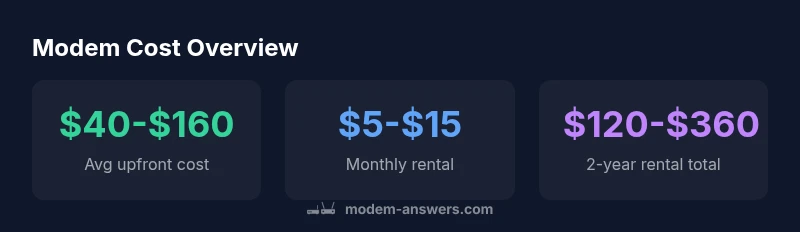
Modem cost varies by approach, but the total cost of ownership is usually higher when renting long-term. Expect upfront hardware costs of about $40-$160 if you buy, plus monthly rental of $5-$15 if you rent. Over 2-3 years, buying often saves money, especially if you already own the modem. This guide from Modem Answers helps homeowners weigh options.
What modem cost covers and why it matters
Modem cost is more than the price on the box. In many households, the total cost of ownership includes upfront hardware, potential rental charges, ongoing maintenance, and the option to upgrade for faster speeds in the future. A narrow focus on the sticker price often leaves homeowners unprepared for monthly fees or renewal costs when plans change. According to Modem Answers, shoppers frequently underestimate ongoing costs when they focus on initial price alone. A clear view of the full cost helps renters and homeowners avoid surprise bills and align their budget with actual internet needs.
Beyond price, consider how your home uses the network: the number of devices, streaming habits, and whether you plan to upgrade to higher speeds. A modem that supports newer DOCSIS standards or better Wi‑Fi performance can reduce the need for frequent replacements, which in turn influences the cost over time. This broader perspective is especially important for households with growing data demands or multiple users.
Bottom line: Modem cost is a balance between upfront hardware investment and ongoing charges. The Modem Answers team emphasizes that the right choice depends on your usage pattern, speed tier, and willingness to manage hardware yourself or rely on ISP support.
How upfront costs shape your decision
Upfront modem costs typically fall into a few broad bands, depending on features and compatibility with your internet plan. Budget models can be enough for basic speeds and fewer devices, while mid-range and high-end models add faster processing, broader range for home Wi‑Fi coverage, and future-proofing against speed upgrades. When you buy, you own the hardware and avoid monthly rental charges, but you shoulder the full upfront expense.
If you’re renting from an ISP, the upfront amount is often wrapped into your first bill or monthly rental. Some providers waive activation fees if you sign a multi-year contract, but others may add one-time charges. The decision point is: do you value predictable monthly costs or a lower initial outlay? Modem Answers finds that many households prefer buying to stop ongoing rental fees, especially when planning for a multi-year horizon.
Ongoing costs: rental vs ownership
Rental costs are simple: a fixed monthly fee that covers service and hardware maintenance. Over time, rentals typically exceed the upfront cost of a decent modem, especially if you stay with the same plan for two or more years. Owning a modem eliminates monthly rental charges, but you must cover warranty considerations and potential future upgrades yourself. A well-chosen modem can serve a family of multiple devices with reliable speeds for several years, reducing the need for constant replacements.
Hidden costs can undermine the math: activation fees, early termination fees, or surcharges for technical support. When evaluating options, list all monthly charges and any non‑recurring fees to compare apples to apples. The goal is to estimate the total cost of ownership over the period you expect to stay with your current plan and equipment.
Tip from Modem Answers: Use a two-year lens when comparing rent versus buy. A model that seems cheaper monthly can become more expensive than a one-time purchase once the time horizon extends beyond the typical contract length.
How to estimate total cost over 2–3 years
To estimate total modem cost, separate upfront hardware from recurring charges and factor in potential speed upgrades. A simple framework looks like:
- Upfront cost (purchase price) or first-month gateway (if rental)
- Monthly cost (rental fee or other ongoing maintenance)
- Duration in months (24–36 months depending on your plan)
- Replacement costs or warranty considerations (if any)
For example, if you buy a modem for $100 and your monthly plan includes $0 in rental, your 24-month total is about $100 (plus any tax or shipping). If you rent at $8 per month, 24 months equals $192, and you’d compare that to the upfront purchase. The key is to aggregate all cash flows over the same horizon, typically 24–36 months, and compare.
This approach helps you avoid the trap of focusing solely on upfront price. Modem Answers recommends building a small spreadsheet that lists all costs by month and then sums them at the end of the planned period. This visibility makes it easier to decide what best matches your usage and budget.
Factors that influence modem cost
Several factors determine modem cost:
- Compatibility with ISP and plan (DOCSIS standard, channel bonding, security features)
- Wi‑Fi performance (coverage, number of antennas, frequency bands)
- Future-proofing (support for higher speeds, software updates)
- Warranty and customer support options (on-site service vs mail-in)
- Hidden fees (activation, early termination, or rental setup charges)
Choosing a modem is not just about price; it’s about ensuring compatibility with your desired speeds and devices. A modem that supports your planned upgrade path, and perhaps a few years of growth, can save you from future hardware purchases and headaches. Modem Answers emphasizes evaluating both current needs and potential speed tiers when assessing cost.
Practical steps to minimize modem cost
Follow these steps to minimize modem cost without sacrificing performance:
- Define your needs: number of devices, typical speeds, and streaming/ gaming usage.
- Check for compatibility: confirm DOCSIS version and ISP-supported features.
- Compare total ownership options: rental vs buy, include upfront and ongoing fees.
- Look for bundles and promotions: some ISPs offer discounted or waived activation fees when buying a modem from them.
- Consider warranty and upgrade paths: a longer warranty can reduce long-term risk and replacement costs.
- Read the contract carefully: watch for hidden fees and renewal terms.
- If buying, choose a modem with proven reliability and good warranty terms from a reputable brand.
By methodically evaluating these factors, you can curb modem cost while preserving performance. Modem Answers suggests drafting a simple financial model to compare alternatives across a 2–3 year window. This practice helps homeowners avoid overpaying for features they don’t need and to invest in capabilities that truly matter for their household.
Common pitfalls and mistakes to avoid
- Focusing only on upfront price without considering ongoing costs.
- Assuming all modems from the same brand perform equally well; performance varies with home layout and device load.
- Ignoring ISP compatibility and speed tier requirements that may render a premium modem unnecessary.
- Missing warranty coverage or misinterpreting terms for returns or replacements.
- Overlooking future needs, such as upgrading to faster speeds or a larger home network.
The takeaway is to balance immediate affordability with long-term value, ensuring your modem choice remains compatible with your evolving internet needs. Modem Answers highlights the importance of a cost-of-ownership mindset when evaluating modem cost.
Modem cost scenarios by type
| Modem Type | Typical Upfront Cost (USD) | Estimated 2-Year Cost (USD) | Notes |
|---|---|---|---|
| Rental modem | 0 | 120-360 | Typically included in monthly plan; activation fees may apply |
| Purchased modem (budget) | 40-70 | 0-40 | Basic DOCSIS modem, suitable for entry-level speeds |
| Purchased modem (mid-range) | 70-150 | 0-40 | Better future-proofing and features such as Wi-Fi 6 |
| Purchased modem (high-end) | 150-300 | 0-60 | Gigabit speeds and advanced features; longer longevity |
FAQ
Is it cheaper to rent a modem or buy one?
In most cases, buying a modem upfront is cheaper over a 2- to 3-year horizon because you avoid ongoing rental charges. If you don’t want to manage hardware, renting can simplify support, but you’ll pay more over time. Compare the total cost of ownership, not just the initial price.
Buying is usually cheaper in the long run, but renting can be convenient if you prefer hands-off service.
Will a newer DOCSIS standard increase modem cost?
Newer DOCSIS standards can raise upfront prices, but they unlock higher speeds and better efficiency. If your plan already supports your needs, upgrading only for speed upgrades may not be cost-effective immediately.
A newer standard costs more upfront but might save you later with faster speeds.
How do I estimate total modem cost over 2-3 years?
Add upfront hardware costs to your projected monthly fees for the chosen period. Use a simple spreadsheet to track rental fees or depreciation. Compare scenarios side by side to find the lowest total cost.
Use a quick calculator or spreadsheet to compare 24- to 36-month costs across options.
Are there hidden fees when renting a modem?
Yes, some ISPs charge activation, maintenance, or early termination fees. Always read the contract and ask about fees before committing to rent. A clear picture helps you avoid surprises.
Watch for activation and termination fees in rental contracts.
Should I upgrade my modem when moving to higher speed tiers?
If your current modem is old or incompatible with the new speeds, upgrading makes sense. Otherwise, assess whether the upgrade brings tangible performance benefits for your usage.
Upgrade only if it directly improves your experience.
“Total cost of ownership matters more than the sticker price when choosing a modem; a slightly pricier option today can remove ongoing rental costs tomorrow.”
Key Takeaways
- Anticipate total modem cost, not just upfront price
- Weigh buy vs rent over a 2–3 year window
- Choose a modem compatible with your speed tier and ISP
- Look for warranties and hidden fees before committing