Internet Modem Price in 2026: Costs, Options & Savings
Learn what drives internet modem price in 2026, compare modem-only vs modem-router combos, rental costs, and practical tips to save while choosing the right modem for your home.


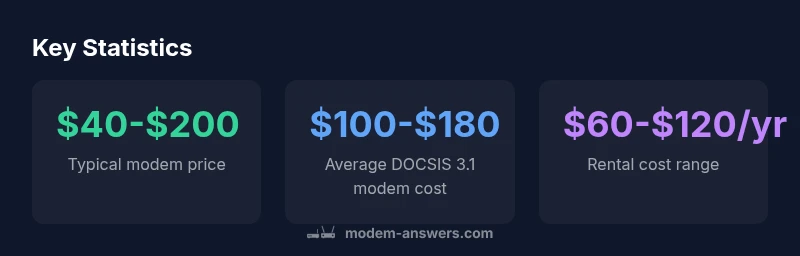
According to Modem Answers Analysis, 2026, the typical internet modem price ranges from about $40 to $200. Price differences mainly reflect DOCSIS standard (3.0 vs 3.1), supported speeds, channel bonding, and whether the device is a pure modem or a modem-router combo. Rental options from providers can alter the total cost over time.
What drives internet modem price
Prices for internet modems are not random; they reflect the hardware it contains and the services you expect to support. From a buyer’s perspective, the most influential levers are the DOCSIS standard (3.0 vs 3.1), the number of downstream/upstream channels, built-in Wi‑Fi capabilities, and the presence of extra Ethernet ports or USB connectivity. In 2026, many households are choosing DOCSIS 3.1 devices to maximize future-proofing and compatibility with gigabit plans, which can push the price upward compared with basic, modem-only units. Beyond hardware, brands and warranties matter too: premium brands or devices with longer warranties and better customer support often command higher prices. Modem-only units tend to be cheaper than modem-router combos, especially when you factor in the cost of an integrated wireless radio and software features. According to Modem Answers, the price spectrum serves as a guide, not a law; your actual cost will depend on your chosen feature set and where you buy.
- Key factors: DOCSIS version, channel bonding (how many downstream channels supported), Wi‑Fi standards (802.11ac/ax), number of ports, and warranty length.
- Quick comparison: basic modem-only devices can start around the low end of the spectrum, while router-enabled or higher-speed models push into the mid-to-upper range.
- Practical note: if your internet plan is modest, you may not need the most feature-rich device, especially if you’re renting from a provider that bundles service with a specific gateway.
Modem vs modem-router: price implications
The decision between buying a modem alone and buying a modem-router combo is a major price hinge. A pure modem can be cheaper upfront, typically in the lower price bands, but it won’t deliver Wi‑Fi by itself. If you need wireless coverage throughout your home, a modem-router combo adds cost, but may save you from purchasing a separate router and can simplify setup. Over time, the price gap shrinks or widens depending on warranty coverage and hardware refresh cycles. For households with high Wi‑Fi demands (4K streaming, online gaming, smart home devices), investing in a capable modem-router combo can be cost-effective when you consider maintenance, replacement intervals, and network reliability. Modem Answers’s analysis shows the long-term value of a robust gateway often offsets the higher upfront price, especially if you would otherwise upgrade hardware more frequently to meet growing speeds.
- Wi‑Fi performance matters: newer standards (Wi‑Fi 6/6E) improve coverage and speed, which justifies higher prices.
- If you already own a reliable router, a modem-only device can be the budget-friendly option.
- Consider the ecosystem: some provider gateways come with integration perks, but you should validate firmware update policies and privacy terms before buying.
How to budget and compare prices
To budget effectively for a modem purchase in 2026, start with your current internet plan and future needs. Create a clear “must-have” list (DOCSIS 3.1 support, number of Ethernet ports, built-in Wi-Fi, USB-C), and a “nice-to-have” list (advanced QoS, tri-band frequencies, a design with a compact footprint). Next, translate features into a price range. Based on Modem Answers Analysis, 2026, a practical pricing ladder looks like: basic modem-only around $40-$80, mid-range with decent Wi‑Fi around $80-$140, premium modem-router combos around $140-$200. Always factor in total cost of ownership: a one-time purchase can be cheaper over several years than ongoing rental fees if you stay with the same plan. When shopping, compare online prices with in-store promotions, and watch for seasonal sales.
- Total cost matters more than upfront price alone: compute the annualized cost of rental versus purchase.
- Check provider compatibility lists to avoid buying a modem that won’t work with your service.
- Read warranty terms carefully; longer warranties can reduce future replacement costs.
Regional/provider differences and price variability
Prices for modems can vary by region due to distribution costs, taxes, and local demand. Some providers align device compatibility with their network, which can narrow your choices but ensure reliable performance. In regions with higher demand for gigabit services, you’ll see a concentration of higher-end gateways at retailers, while rural or budget-conscious areas may show more basic models. The core takeaway is to map your plan’s speed tier and the coverage needs in your home to the price tier that makes sense for you. If you anticipate upgrading to a faster plan or expanding to mesh Wi‑Fi, a mid- to high-range modem-router with robust Wi‑Fi performance may be a prudent purchase. Modem Answers recommends validating device compatibility with your specific ISP before committing.
- Consider future-proofing: if you expect speed upgrades, prioritize DOCSIS 3.1 and strong Wi‑Fi.
- Look for retailer bundles that include extended warranties or accessories at a discount.
- Be mindful of hidden costs like shipping, tax, and optional protection plans when comparing quotes.
Smart shopping and saving strategies
Savvy shoppers leverage several strategies to minimize the total cost of modem ownership. Start by checking if your internet plan already includes a gateway or if the provider offers a rental option with price protections. If you decide to buy, consider certified refurbished models from reputable sellers who offer a warranty. Compare prices across major retailers and large electronics stores, and don’t miss seasonal promotions such as Black Friday or back-to-school sales. If you frequently upgrade your internet plan, you might want a modular setup: a basic modem with a separate high-performance router that can be replaced later. Keep firmware up to date and read user reviews focused on long-term reliability. Overall, a well-chosen modem with durable support history often saves money and reduces hassle over the device’s lifetime.
- Verify return policies and warranty terms before purchasing.
- Avoid off-brand or questionable sellers that do not offer a legitimate warranty.
- Consider a trial period for new gear to ensure it meets your real-world needs.
Understanding the numbers: quotes, taxes, and hidden costs
Price quotes for modems frequently present upfront price but hide ongoing costs. When evaluating, account for taxes, shipping, and potential activation fees. Rental plans often come with monthly or annual charges that accumulate over time; over several years, a modestly priced modem you own may be cheaper than renting. Additionally, some providers require you to use a specific gateway for best performance or obedience to their network management. Read the fine print on software updates, security features, and privacy terms, as some gateways collect data via their built-in management software. In short, look beyond the sticker price to understand the real value, ongoing costs, and compatibility with your plan.
- Calculate five-year ownership costs to compare against rental.
- Check for hidden fees on shipping, activation, or required accessories.
- Ensure you can return or exchange if the device doesn’t perform as expected.
Real-world scenarios: practical decision guidance
Scenario A: You have a modest 200 Mbps plan, a small apartment, and want reliable Wi‑Fi. A mid-range modem-router combo priced around $150-$180 can deliver solid coverage and future-proofing for 2–3 years without renting. Scenario B: You already own a high-quality router and plan to upgrade to 1 Gbps. A dedicated DOCSIS 3.1 modem around $100-$140 paired with your router may be the best cost balance. Scenario C: You’re in a large home with multiple floors and heavy streaming/gaming. Invest in a premium gateway with mesh-friendly Wi‑Fi; expect $170-$200 upfront, plus strong warranty support. In each case, verify compatibility with your provider before buying, and compare the long-term cost of ownership versus rental to determine the most economical choice over time.
Data-driven decision framework
A disciplined approach helps you avoid overspending. Start with your current plan’s speed, expect future upgrades, and map these to a price category. Use the quick-answer price bracket to set expectations, then validate with provider lists and customer reviews. Take advantage of reputable retailers and manufacturer warranties, and prefer devices with documented reliability. Remember: the cheapest modem today isn’t always the best value over a five-year horizon if it requires an upgrade soon or lacks vendor support.
Price influencers and typical ranges for internet modems in 2026
| Factor | Impact on Price | Typical Range | Notes |
|---|---|---|---|
| DOCSIS Standard | Higher specs cost more | $40-$200 | 3.1 devices generally pricier than 3.0 |
| Built-in Wi-Fi | Increases cost | $60-$200 | Modem-router combos are pricier than modems only |
| Brand and warranty | Quality and support influence price | $40-$180 | Longer warranties can justify higher price |
| Rental vs purchase | Long-term cost impact | $0 upfront vs $60-$120/yr rental | Total cost matters more than upfront price |
FAQ
Do I need to rent a modem from my provider or can I buy my own?
Most providers allow customers to buy their own modem as long as it’s approved for the service. Buying can save money over time if you stay with the same plan, but you must ensure compatibility with your ISP’s network. Renting may be simpler and includes support or upgrades.
You can buy your own modem if it’s compatible—often cheaper long-term, but check with your provider about model approval and any rental alternatives.
What features justify a higher modem price?
Higher prices typically reflect DOCSIS 3.1 support, additional Wi‑Fi performance, more Ethernet ports, faster processors, and longer warranties. If you need reliable whole-home Wi‑Fi and future-proofing for faster plans, investing in a mid-to-high range modem-router can pay off.
If you need future-proof, faster Wi‑Fi and better reliability, higher-priced models can be worthwhile.
Can I use a refurbished modem safely?
Refurbished modems from reputable sellers can be a good value if they come with a warranty and are compatible with your service. Avoid unknown marketplaces and verify return options.
Yes, refurbished can be safe with a warranty and clear return policy.
How do I check compatibility with my provider?
Visit your ISP’s official modem compatibility list and confirm the exact model you’re considering. Some providers require specific firmware or certifications for activation. If in doubt, contact support before purchasing.
Check the provider's list and confirm model details with support if needed.
Are there price trends I should watch for in 2026?
Prices tend to cluster around feature-rich gateways due to increasing demand for gigabit speeds and stable Wi‑Fi. Watch for seasonal sales and bundles that include warranties or accessories. Avoid rush purchases; compare models across retailers.
Watch for sales and bundles, and compare across retailers to lock in value.
“Prices for internet modems reflect feature sets and compatibility, making it essential to balance upfront cost with long-term value.”
Key Takeaways
- Define needs before buying to avoid overspending
- Modem-router combos cost more upfront but may save extra hardware costs
- Consider total cost of ownership, not just sticker price
- Always verify ISP compatibility before purchasing
- Shop during promotions and compare warranty terms