Netgear Nighthawk CM1200 Cable Modem: Setup, Performance & Tips
Explore the Netgear Nighthawk CM1200 cable modem: setup, performance, compatibility, and tips for Gigabit plans. Learn placement, speed testing, bridge mode, and monitoring for a reliable home network.


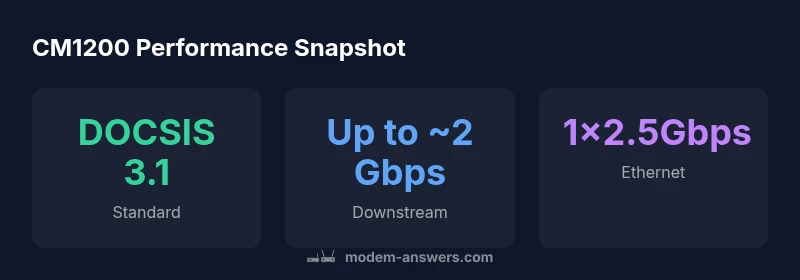
The netgear nighthawk cable modem cm1200 is a DOCSIS 3.1 modem designed to deliver multi-gigabit speeds when used with a compatible plan. Real-world speeds depend on your provider, plan tier, and network conditions. The CM1200 supports link aggregation and a 2.5 Gbps Ethernet port, making it a strong option for Gigabit internet.
Understanding the CM1200 in a Home Network
The netgear nighthawk cable modem cm1200 is best understood as a high-performance bridge between your coaxial internet supply and your home network. It is a DOCSIS 3.1 modem, designed to pair with a separate router to provide wireless coverage and robust local networking. For homeowners who subscribe to Gigabit or multi-Gigabit service, the CM1200 can remove bottlenecks at the network edge when matched to a capable router. In practice, the actual speeds you experience depend on the provider’s tier, the quality of the coax line to your residence, and the performance of your router.
According to Modem Answers, its emphasis is on reliable downstream performance and a resilient uplink when the right router and network layout are in place. This makes the CM1200 particularly well-suited for modern homes with multiple devices streaming, video conferencing, and cloud backups. The model’s value is not just raw speed, but consistency and ease of integration with existing gear.
DOCSIS 3.1: Why It Matters for Gigabit Internet
DOCSIS 3.1 is the backbone that enables multi-gigabit service on cable networks. In real-world terms, this standard supports higher modulation schemes, better spectrum efficiency, and wider channel bonding. The CM1200’s DOCSIS 3.1 compatibility is what allows you to achieve higher sustained speeds when your service tier supports it. However, match this modem with a router that can handle high-throughput traffic and with a provider plan that permits multi-gig channels for optimal results. If your plan caps speeds well below the modem’s peak, you’ll still benefit from improved stability and latency.
When planning a network upgrade, consider how your devices use bandwidth: 4K streaming in multiple rooms, online gaming, and large file backups all benefit from a modem that minimizes bottlenecks at the transition point between ISP and home network. Modem Answers’s guidance emphasizes that DOCSIS 3.1 is a strong foundation, but the router and the internet plan ultimately shape your day-to-day experience.
Key Specifications and What They Mean for You
The CM1200 is a modem-only device with a single 2.5Gbps Ethernet port and no built-in Wi‑Fi. That design choice reflects a philosophy: let a high-performance router handle wireless coverage and local features while the modem focuses on reliable broadband transcoding. Practical implications include easier firmware management for the modem, more flexible router choices, and the ability to upgrade your Wi‑Fi experience without replacing the entire gateway.
From the user perspective, the most important specs are the DOCSIS version, the maximum downstream/upstream capabilities, and the available port speed. While maximum theoretical speeds look attractive, your real speed will be limited by the ISP tier, the quality of the coax line, and how you configure your network hardware. For most households, pairing the CM1200 with a modern router delivers excellent performance for a multi-device environment.
Setup and Activation: A Practical Flow
Getting started with the CM1200 involves three main steps: connect the coaxial cable, activate with your ISP (sometimes via a web portal or phone call), and connect the Ethernet cable to your router. If you plan to use the CM1200 in bridge mode, ensure you configure your router to take full control of IP addressing and security settings. Activation times can vary by provider, but most users see service after a short provisioning window. Keep a watchful eye on the status lights: solid power and online indicators generally mean the unit is ready. Modem Answers recommends documenting the MAC address and serial number for quick reference during activation.
Bridge Mode vs. Router Mode: Which Is Right for You?
Bridge mode effectively turns the CM1200 into a pure modem, letting your own router handle all routing and wireless. This setup can simplify firmware updates and give you more control over security and parental controls. On the other hand, router mode keeps the CM1200 as a gateway and may be easier for users who prefer fewer devices on the network edge. In practice, many homes with heavy Wi‑Fi usage benefit from a modern router with strong mesh capabilities; using bridge mode allows that router to architect the entire network while the CM1200 provides a clean, stable internet connection.
Practical Tips to Optimize Performance
- Place the CM1200 in a central location away from walls and metal objects to reduce interference. A shelf or cabinet with good airflow is ideal.
- Use Ethernet for high-priority devices: gaming consoles, desktop workstations, and streaming devices. A 2.5Gbps port helps if you have a multi-device LAN.
- Run regular speed tests with a wired PC directly from the CM1200 and then through your router to isolate bottlenecks.
- Consider firmware updates for both modem and router; firmware often includes security patches and performance improvements.
- If you experience inconsistent performance, reboot both modem and router in a controlled sequence to refresh sessions and paths.
Common Mistakes and How to Avoid Them
Many users misinterpret modem speed caps as actual fixed speeds. Real-world results reflect service tier, line quality, and network congestion. Overestimating your IPTV or gaming needs without upgrading router capacity can also throttle performance. Finally, placing the modem in a closed cabinet or behind thick walls can degrade signal; always prioritize ventilation and visibility for stable operation.
CM1200 at a glance
| Aspect | CM1200 | Notes |
|---|---|---|
| Modem Type | DOCSIS 3.1 | Latest standard for cable networks |
| Max Downstream/Upstream | Up to around 2 Gbps / 1 Gbps | Provider plan dependent |
| Wi-Fi Built-in | None | Requires separate router/access point |
| Bridge Mode | Yes | Can be paired with own router |
FAQ
Is the CM1200 compatible with my internet provider?
The CM1200 is a DOCSIS 3.1 modem designed to work with most major cable providers. Check with your specific plan to confirm supported speeds and activation requirements.
Yes, it's compatible with most major cable providers, but confirm with your plan.
Does the CM1200 include built-in Wi‑Fi?
No. The CM1200 is a modem-only device and requires a separate router for wireless coverage.
No built-in Wi‑Fi; you’ll need a router for wireless access.
Can I use bridge mode with the CM1200?
Yes. You can enable bridge mode to let your own router handle routing, firewall, and network features.
Yes, you can use bridge mode with a separate router.
What should I test first after setup?
Test wired performance first directly from the CM1200, then test through your router. Use speed tests and latency checks to gauge where improvements are needed.
Test wired, then test through your router to identify bottlenecks.
How important is placement for performance?
Placement affects signal quality. Keep the modem off the floor, away from obstructions, and in a ventilated space for consistent performance.
Placement matters; position in a central, ventilated spot.
“The CM1200 is a solid foundation for Gigabit networks when paired with a capable router and a quality coax line.”
Key Takeaways
- Pair CM1200 with a capable router for best Wi‑Fi performance
- Expect real-world speeds to mirror your ISP plan and line quality
- Use bridge mode if you want full control of routing and security
- Place the modem in a central, ventilated spot for consistency