Is Your Modem Compatible? A Practical Guide
Learn how to verify if your modem is compatible with your ISP, understand DOCSIS standards, read provider lists, and activate a new modem with confidence. A comprehensive, step-by-step guide by Modem Answers.


Is your modem compatible with your ISP? This guide shows you how to confirm compatibility, focusing on DOCSIS standards, provider-approved lists, and activation steps. You’ll need your modem model, your service plan, and access to your provider’s portal. Follow the steps to avoid activation delays and ensure reliable connectivity.
Is Modem Compatibility a Real Concern?
Yes. Whether you rent a modem from your provider or bring-your-own (BYO), compatibility determines whether you can activate service, achieve stable speeds, and receive timely support. According to Modem Answers, most users encounter issues when they assume compatibility without validating against DOCSIS standards and their ISP’s approved device list. The Modem Answers team found that a thoughtful verification process—covering model numbers, firmware, and activation prerequisites—reduces onboarding friction and helps you avoid surprises after installation. As a homeowner or renter, you want a device that works today and remains supported tomorrow, which is why a deliberate check is worth your time.
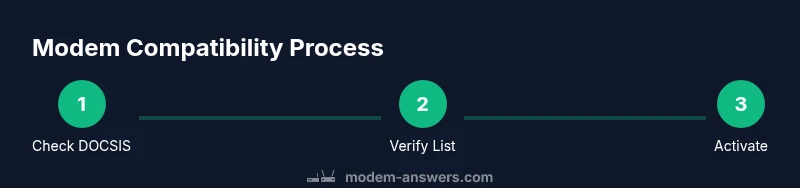
In practical terms, you are checking three things: (1) the hardware standard your modem uses (DOCSIS for cable, or an equivalent for other networks), (2) the provider’s explicit device compatibility list, and (3) whether your service plan supports your chosen device. When in doubt, start with the provider’s official pages and your modem’s documentation. This upfront diligence saves you from late activations, unexpected outages, or the need to return a new modem after an installation window has passed.
Understanding the Basics: DOCSIS, Protocols, and Network Roles
Before diving into lists and activations, it helps to know the core terms. DOCSIS (Data Over Cable Service Interface Specification) defines how data travels over cable networks. Modern households commonly rely on DOCSIS 3.0 or 3.1 devices; some providers also support newer standards or hybrid fiber cases. Your modem’s model number and DOCSIS version influence maximum downstream/upstream speeds and channel bonding capabilities. In addition, you’ll want to understand whether your device is a standalone modem or a modem-router combo, because this distinction affects whether you should place your own router behind the modem or use a bridge mode. This foundation matters for speed tests, firmware updates, and future-proofing your home network. The Modem Answers team emphasizes that while speed tiers are important, compatibility hinges on the specific DOCSIS variant your service plan can support and the list your provider maintains.
How to Read Your ISP’s Compatibility List (and Why It Matters)
ISPs publish device compatibility pages with model numbers, MAC addresses, and supported service plans. The key is to cross-check your exact modem model against the list, not just the brand. Look for notes about firmware requirements, regional availability, and activation steps. Some providers require you to register the device in advance, while others activate automatically when you connect. If your model isn’t listed, you may still be able to activate through a contractor-assisted process or by using a gateway device from the approved catalog. Always verify current status on the provider’s site before purchasing a new modem. This careful verification saves you the trouble of troubleshooting post-purchase.
Common Scenarios: Cable, DSL, and Fiber Gateways in Everyday Homes
Most homes rely on cable modems (DOCSIS) or fiber gateways (ONT/ONT-compatible devices). Cable modems pair with a coaxial cable and often connect to an external router, or act as a router themselves. DSL setups use different hardware standards and may require specific DSLAM compatibility. Fiber homes use an optical network terminal (ONT) that requires different onboarding steps. In all cases, check the provider’s documentation for the exact model compatibility and activation method. If you’re renting from your provider, you’ll often find the latest supported models in your account portal. If you’re BYO-ing a device, ensure your model is explicitly listed for your plan and location.
Activation and Onboarding: What to Expect When You Bring a Modem
Activation usually involves a quick pairing between the modem’s MAC address and your service account. Expect prompts in a browser or mobile app to confirm service type and plan. You may be asked to run a reboot sequence, confirm signal levels, and verify that downstream and upstream channels meet baseline thresholds. If activation stalls, check for an incorrect MAC entry, improper cabling, or a locked account requiring a service call. Having your account number, modem model, and serial number handy speeds things up. The modem should show a stable link and the provider’s light indicators will typically indicate online status.
Troubleshooting When a Modem Isn’t Listed or Fails Activation
If your device isn’t on the compatibility list, you have options. First, contact your provider to confirm whether the device can be activated and whether a firmware update is required. If activation still fails, you can request a different approved modem or consider bridging a BYO router behind an approved modem. Be prepared with your service address, plan, and the exact model, as support teams use these details to resolve issues quickly. Remember that some issues are transient, so a retry after a few minutes can sometimes resolve a linking problem. Modem Answers guides users to exhaust provider-supported paths before opting for third-party workarounds.
Buying Guidance: A Practical Checklist for Modem Purchases
When shopping for a new modem, prioritize models explicitly listed by your ISP, or those widely supported across major providers. Check DOCSIS version, offered speeds, channel bonding, and warranty terms. Consider future-proofing with DOCSIS 3.1-capable devices if your plan’s upgrade path is uncertain. Compare energy usage and size to fit your space. If you already own a router, ensure the modem supports bridge mode or has a robust management interface. A well-chosen modem will streamline future activations and reduce compatibility headaches.
Security, Firmware, and Maintenance Considerations for Long-Term Use
Keep firmware up to date to protect against vulnerabilities and to maintain compatibility with evolving networks. Use official update channels provided by the manufacturer or your ISP. Disable features you don’t need and ensure admin access is secured with a strong password. Regularly review the device’s status pages for signal quality, channel bonding, and uptime. Modem Answers stresses that consistent firmware updates and configuration hygiene help preserve reliability and security over the device’s lifetime.
Quick Wins: What to Do This Weekend to Improve Compatibility and Performance
First, identify your exact modem model, DOCSIS version, and current firmware. Then, verify the model against your ISP’s compatibility page and update firmware if prompted. If you’re upgrading, consider a BYO modem that is on the approved list and has a future-proof DOCSIS 3.1 or higher. Finally, run a controlled speed test after activation to confirm you’re achieving plan-accurate performance. With a clear plan, you can avoid surprises and enjoy a smoother home network.
Tools & Materials
- Your modem model number(Found on the device label; include DOCSIS version if cable modem.)
- ISP service plan and account details(Have your login credentials and plan name handy.)
- Coaxial or ethernet cables(Coaxial for cable modems; ethernet to connect to router or PC.)
- Router (optional) or device to configure network(Use if you plan to create a separate home network behind the modem.)
- Computer or mobile device with browser(Used to access activation pages and admin interfaces.)
- Pen and notebook or digital notes(Record MAC addresses, activation IDs, and steps taken.)
Steps
Estimated time: 25-45 minutes
- 1
Gather model and plan details
Collect your modem’s exact model number, DOCSIS version (if cable), and your current service plan. Verify you have the correct account credentials for activation. Prepare the activation URL or contact method from your ISP.
Tip: Having the exact model and DOCSIS version reduces back-and-forth with support. - 2
Check the ISP compatibility list
Visit your ISP’s site and locate the official device compatibility page. Cross-check your modem model and note any firmware prerequisites or regional limitations. If your model isn’t listed, contact support before purchasing.
Tip: Copy the model number exactly as shown on the device label. - 3
Prepare hardware connections
Connect the coaxial cable to the modem if you’re using a cable modem; connect an ethernet cable from the modem to your router or computer. Ensure power is supplied and the device is powered on before proceeding.
Tip: Only hand-tighten coax connections to avoid nut damage. - 4
Activate the modem with your ISP
Open the activation page or call the activation line as instructed by your provider. Enter the MAC address if prompted and follow on-screen prompts. Wait for the online confirmation that the device is online.
Tip: If activation stalls, reboot the modem and router, then retry. - 5
Verify signal and performance
Check downstream/upstream channel status and power levels using the modem’s admin page or the provider’s portal. Run a speed test to compare against your plan’s advertised speeds. Ensure there are no error codes.
Tip: Consistent speeds near plan tiers indicate healthy compatibility. - 6
Test and document results
Document activation success, speeds, and any anomalies. Save screenshots of status screens and write down the exact steps you took. This helps if you need to escalate a support issue later.
Tip: Have a reference ready when you contact support. - 7
If not listed, explore alternatives
Request an approved modem from your provider or consider using a bridge mode with your own router if compatibility remains an issue. Avoid unsupported configurations that compromise service.
Tip: Bridge mode can preserve performance when using a separate router.
FAQ
What does DOCSIS stand for and why does it matter for compatibility?
DOCSIS stands for Data Over Cable Service Interface Specification. It defines how data travels over a cable network. Compatibility depends on whether the modem’s DOCSIS version and capabilities match what your ISP supports.
DOCSIS is the standard for cable networks. Make sure your modem’s DOCSIS version matches your provider’s supported range.
How can I tell if my modem is compatible with my plan?
Start with your ISP’s official compatibility page. Enter your modem model and check for firmware notes and regional constraints. If listed, follow activation steps; if not, contact support before purchasing.
Check the official compatibility page and follow activation steps if listed.
Can I use a modem from a different provider?
It’s possible if the modem is on the provider’s approved list and supports your plan. Some providers require firmware or a specific activation path.
Yes, if the modem is approved by your provider and matches your plan.
What should I do if my modem isn’t listed as compatible?
Contact your ISP to confirm if the device can be activated or if there’s an approved replacement. Consider a modem on the official list or bridging a BYO router with an approved modem.
Ask your provider about activation options or alternatives.
How do I bridge a modem and router if required?
Enable bridge mode on the modem if supported, then use your own router for network management. This often helps when the modem isn’t ideal for routing tasks.
Bridge mode lets your router handle the network.
Is there a cost to activate a BYO modem?
Activation may be free or vary by provider. Always check the activation policy in your account or with customer service before buying a new modem.
Activation costs vary by provider; check policy first.
Watch Video
Key Takeaways
- Verify DOCSIS version and provider compatibility before purchase
- Always cross-check exact model numbers against the official list
- Activate through the provider’s portal to avoid activation delays
- Test speeds after activation and document results