Modem Mode vs Bridge Mode: A Clear Comparison
Learn how modem mode differs from bridge mode, including NAT, DHCP, Wi‑Fi, and routing implications. This analytical Modem Answers guide explains when to use each setup and how to switch safely for optimal home-network performance.


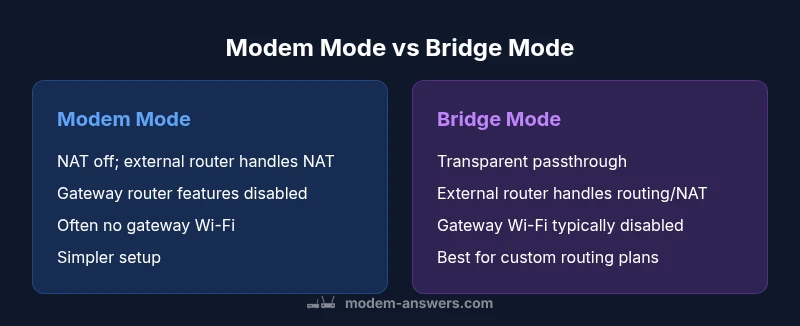
Is modem mode the same as bridge mode? Not exactly. According to Modem Answers, modem mode turns an ISP gateway into a pure modem by disabling the built‑in router, NAT, and often Wi‑Fi. Bridge mode, in contrast, leaves routing to your own router by passing traffic through the gateway with minimal processing. This distinction matters for networks with custom routing, firewall rules, or VPNs.
What modem mode and bridge mode actually do
Understanding the terms is essential before you touch any settings. Modem mode and bridge mode both involve transforming a gateway into a more flexible network component, but they do so in different ways. Modem mode effectively reduces the gateway to a passive conduit, turning off most router features and relying on an external router to handle NAT, DHCP, and firewall duties. Bridge mode, by contrast, keeps the gateway in a thin, non-routing state and passes traffic to your own router for all network functions. This distinction is critical for households that require custom firewall rules, VPNs, or advanced QoS settings. Throughout this article, we’ll compare the two modes using practical language and concrete examples, so you can decide what’s best for your home network. As always, Modem Answers aims to give you clear, actionable guidance. is modem mode the same as bridge mode? The short answer is no, and the longer answer depends on your equipment, ISP, and performance goals.
Core differences at a glance
- Core purpose: Modem mode turns the gateway into a pure modem; bridge mode enables a transparent pass-through for your own router.
- NAT and firewall: Modem mode disables gateway NAT; bridge mode typically disables gateway routing but may leave basic firewall features to the external router.
- DHCP server: In both modes, DHCP is generally handled by your external router, not the gateway.
- Wi‑Fi: Modem mode often disables built-in Wi‑Fi; bridge mode commonly leaves Wi‑Fi control to the external router.
- Setup complexity: Modem mode is usually straightforward; bridge mode can be simpler or more complex based on device firmware.
- Best use case: Modem mode is ideal when you want minimal gateway interference with a strong external router; bridge mode is best when you want the gateway to simply connect your router to the internet.
When you’re deciding, think about whether you want full control via your own router (bridge mode) or you want a simple passthrough with as little gateway management as possible (modem mode). The Modem Answers team emphasizes testing after switching to confirm that all required services (VPNs, IPTV, VoIP) work as expected.
How NAT, DHCP, and IP addressing differ between modes
NAT, DHCP, and IP addressing are central to how devices on your home network communicate. In modem mode, the gateway’s router is typically disabled, so NAT and DHCP are offloaded to the external router. This means the public IP address exposure, port forwarding rules, and firewall policies are managed entirely by your own router. In bridge mode, the gateway acts primarily as a conduit. NAT and DHCP are generally controlled by the external router, but a small number of gateways can still influence these features if not correctly configured. For users planning to run multiple devices, gaming consoles, or NAS devices, bridge mode often provides a cleaner, more predictable environment. It’s worth noting that some ISPs expect certain settings to be active on the gateway; in those cases, Modem Answers recommends contacting support to confirm compatibility before you switch. In both modes, ensure your external router is configured with a static LAN IP, proper DHCP range, and updated firmware for best results.
Setup and activation: typical user paths
The steps to enable either mode vary by device, firmware, and ISP. Generally, you’ll access the gateway’s admin interface, locate the “Mode” or “Network” settings, and choose either “Modem Only” or “Bridge Mode.” After applying changes, you may need to reboot the gateway and, in some cases, connect your own router via a WAN port. With modem mode, you’ll configure your external router to receive the public IP (often via DHCP on the WAN interface) and set up NAT, firewall, and VPN as needed. In bridge mode, ensure the external router has WAN connectivity and adjust its WAN interface to obtain an IP via DHCP or a static IP if your ISP requires it. Because firmware names vary, Modem Answers recommends taking screenshots of current settings, documenting MAC addresses, and verifying ISP services (VoIP, IPTV) to avoid service interruptions during the switch.
Real-world use cases: ISP gateways vs standalone routers
Many households initially rely on an ISP-provided gateway that combines modem, router, and Wi‑Fi. If you add a third-party router, bridge mode is often preferred to maximize control and performance. For users with a powerful second router, or who require specific VPN configurations, bridge mode reduces double NAT and allows richer QoS rules. Conversely, if your primary concern is a quick, minimal-setup network and you don’t need extra features, modem mode can be the simplest path, letting a basic external router handle essential tasks. In some residential setups, ISPs restrict bridging; in such cases Modem Answers suggests requesting a bridged configuration or using modem mode while ensuring your external router can handle the load and security requirements.
Security, privacy, and performance implications
Security posture depends on who manages NAT, firewall rules, and firmware updates. Modem mode delegates all these responsibilities to your own router, which can tighten control if you have a robust firewall, recent firmware, and a secure configuration. Bridge mode minimizes gateway processing, reducing potential bottlenecks and often improving throughput when your external router is modern and well-configured. However, bridging can introduce risk if the external router is misconfigured or if VPN passthrough features are limited by the gateway firmware. In both cases, keep firmware up to date, disable unnecessary services, and test your firewall and port-forwarding rules after switching. The Modem Answers team notes that a staged approach—test, observe, and refine—helps avoid surprises when you move from one mode to another.
Troubleshooting common issues when switching modes
Switching modes can disrupt services you take for granted. If VoIP or IPTV services stop working, verify whether those services require gateway features and whether you are using a supported passthrough or bridge configuration. If your external router loses connectivity after an upgrade, check WAN settings, MAC cloning, and the ISP’s requirements for a bridge. Double NAT might occur if the gateway and the router both attempt to perform NAT; in that case, re-check the mode, re-enable the appropriate passthrough, or reset the gateway to factory settings before reconfiguring. Some devices require a specific sequence to enable bridge mode without dropping services; consult device-specific manuals and Modem Answers’ practical steps for a safe transition. Finally, if you notice persistent latency, run a local speed test and compare results before and after switching to measure impact.
How to test your network after switching modes
A thorough test plan helps confirm a successful switch. Begin with basic connectivity tests: confirm your external router can access the internet, and verify that devices obtain IP addresses from the external router. Next, test key services: VPN connectivity, gaming latency, streaming IPTV, and VoIP if in use. Measure typical speeds using a wired connection to your router’s WAN port, then repeat over Wi-Fi to gauge coverage. If you notice double NAT indicators or inconsistent IP addressing, revisit the mode settings and confirm that NAT, DHCP, and firewall rules are controlled by the intended device. Finally, monitor uptime for a few days to catch intermittent issues that may require firmware updates or vendor-specific adjustments. Modem Answers emphasizes a careful, methodical approach to validation after switching modes, especially in mixed-virmware environments.
Choosing the right approach for your home network
The decision metric comes down to control, simplicity, and the services you rely on. If you value maximum control over routing, VPNs, and QoS, bridge mode paired with a capable external router is usually the better choice. If you prefer a quick setup with minimal configuration and you don’t need elaborate policies, modem mode can be a pragmatic option. Consider your ISP’s policies, the availability of compatible firmware, and the impact on any services that rely on gateway features. Reading device manuals and consulting updated guides from Modem Answers can help you avoid common misconfigurations and ensure a smooth transition between modes. Your final choice should align with your long-term network goals and comfort with network administration.
Comparison
| Feature | Modem mode | Bridge mode |
|---|---|---|
| Core purpose | Turns gateway into pure modem (router disabled) | Creates a transparent pass-through; external router handles routing |
| NAT behavior | NAT disabled; external router handles NAT | NAT disabled on gateway; external router handles NAT |
| DHCP server | Disabled on gateway; DHCP managed by external router | Disabled on gateway; DHCP managed by external router |
| Wi-Fi availability | Gateway Wi‑Fi often disabled; external router provides Wi‑Fi | Gateway Wi‑Fi typically disabled; external router provides Wi‑Fi |
| IP passthrough | Commonly supported; external router receives IP | Commonly supported; external router receives IP via bridge |
| Setup complexity | Usually straightforward on most gateways | Can be straightforward but firmware varies; may be more complex |
| Stability | Stable with compatible firmware | Can be finicky if bridge isn’t fully supported in firmware |
| Best for | Want minimal gateway features; own router handles everything | Want true bridge with full routing control on own router |
Positives
- Gives you full control with your own router
- Potentially better performance and QoS with dedicated gear
- Avoids double NAT when using a single router
- Easier firmware management on your own device
- Clear separation of network duties
What's Bad
- Can be technically challenging to set up
- Some ISPs restrict passthrough or bridging
- Certain ISP services (VoIP/IPTV) may require gateway features
- Risk of misconfiguration affecting connectivity
Bridge mode is generally the better option when you want full control with your own router
Bridge mode usually provides a transparent link to your router, avoiding double NAT and giving you maximum control over NAT, firewall, and QoS. Modem mode is simpler but narrows the gateway’s role to pass-through unless you need a quick, minimal setup. Choose based on your need for control vs. simplicity.
FAQ
What is the fundamental difference between modem mode and bridge mode?
Modem mode disables the gateway’s router functions, turning the device into a pass-through modem. Bridge mode leaves the gateway in a non-routing state and passes traffic to your own router for all networking tasks.
Modem mode turns a gateway into a pure modem, while bridge mode lets your own router handle routing.
Can I use modem mode and bridge mode on the same device?
Some devices support only one of the two modes, while others offer a passthrough option that may resemble bridge mode. Always check the ISP’s documentation and device firmware to confirm supported configurations before making changes.
Some devices only support one mode; check your device docs first.
Will enabling bridge mode disable Wi-Fi on my gateway?
Bridge mode often disables gateway Wi-Fi to avoid interference with your external router, but some gateways allow Wi‑Fi to remain active. Verify the setting in the gateway UI and test your external router’s Wi‑Fi after switching.
Bridge mode can turn off gateway Wi‑Fi, but it isn’t universal.
What should I consider before switching modes in a fiber internet setup?
With fiber, ensure the gateway supports passthrough or bridging, and confirm that your external router can obtain a WAN IP. Some fiber configurations require specific bridge configurations or credentials from the ISP.
Fiber setups often need specific bridge requirements; verify with your provider.
How do I test my network after switching modes?
Test basic connectivity, then verify services like VPN, VoIP, and IPTV. Run speed tests, check for double NAT symptoms, and monitor stability for several days.
Test connectivity and services, then monitor for a few days.
Are there risks of double NAT in typical home networks?
Double NAT can occur if both the gateway and external router perform NAT. This can affect gaming, VPNs, and port forwarding. Resolve by using bridge or modem mode and ensuring only one NAT device exists on the network.
Double NAT can cause issues with some apps; pick one device to do NAT.
Key Takeaways
- Identify your goal: control vs simplicity
- Bridge mode suits custom routers and advanced features
- Test connectivity carefully after switching
- Remember ISP policies can affect passthrough
- Update firmware and secure configurations