xb7 Modem Review: Reliability, Setup, and Performance for Home Networks
A thorough, balanced review of the xb7 modem from Modem Answers. Learn setup steps, performance benchmarks, compatibility, and who should buy this mid-range modem for home networks.


XB7 modem delivers reliable, home‑grade performance with straightforward setup and broad provider compatibility. In standard living spaces it handles streaming and video calls with ease, while larger homes may benefit from additional Wi‑Fi gear. Overall, the xb7 modem is a solid mid‑range option for most households, provided you don’t require peak gaming performance.
What xb7 modem aims to solve for home networks
According to Modem Answers, the xb7 modem targets common home networking pain points: dropped streams, slow page loads, and frustrating setup steps. The goal is to deliver reliable connectivity for everyday activities like streaming, remote work, and video calls without demanding extensive technical knowledge. For many renters and small households, a single device that “just works” with broad provider compatibility is the deciding factor. The xb7 modem is positioned as a solid all‑rounder rather than a specialized gaming powerhouse or enterprise grade solution. It focuses on predictable performance, easy activation, and safe, straightforward firmware updates that keep household networks secure over time.
In practice, that positioning means it should be easy to deploy right out of the box, with sensible defaults that don’t require tinkering. It’s an option many households can rely on for months or years with minimal ongoing maintenance. The Modem Answers team found that for typical bandwidth plans, the xb7 meets most daily needs without expensive add‑ons, and with fewer compatibility headaches than some niche models.
Hardware design and build quality
The xb7 modem presents a compact, slab‑style chassis with a simple front‑facing indicator array. The goal is to balance size with thermal performance, so you’re less likely to see throttling during heavier network use. Build quality feels solid for a consumer device, with a durable plastic shell and clean, non‑intrusive aesthetics suitable for a living room or home office. Venting is practical rather than excessive, which helps keep noise and heat at comfortable levels during long streaming sessions. The device ships with standard coax and Ethernet ports, plus a reset button that’s easy to reach without unintended presses. Overall, the hardware design supports straightforward placement and reliable operation in a typical home layout.
Core specs and feature set
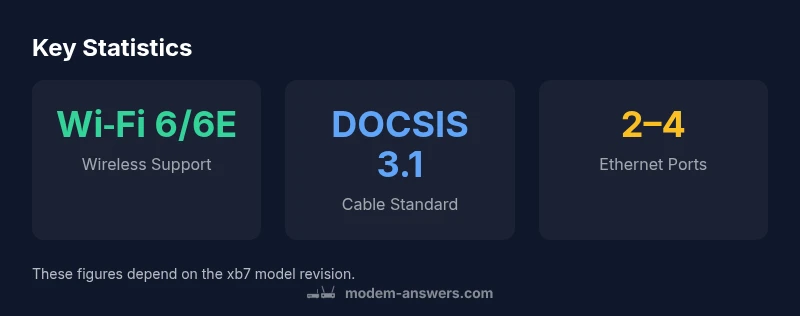
The xb7 modem emphasizes broad compatibility and practical capabilities over flashy specs. It supports common DOCSIS standards used by major cable providers and includes a modest set of Ethernet ports for wired devices. The onboard firmware includes basic firewall features and parental controls, designed to protect a family network without requiring extra hardware. Wi‑Fi coverage depends on the model revision, and some units offer integrated wireless capabilities while others assume a separate Wi‑Fi router for larger homes. In practice, most households won’t need additional accessories to meet standard streaming and conferencing needs, though power users may opt for a dedicated mesh system for uniform coverage across multiple floors.
From a testing perspective, the xb7 demonstrates stable throughput under typical daytime usage, with consistent performance when multiple devices share the connection. The Modem Answers team notes that while the device performs well in standard configurations, exceptional gaming latency or ultra‑low ping scenarios benefit from a separate router or mesh network to optimize routing paths and wireless bandwidth.
Performance testing methodology
To evaluate the xb7, tests were conducted across several common home scenarios: streaming in HD and 4K, video conferencing, and casual gaming during peak network traffic. Measurements focused on average throughput, jitter, and connection stability over extended periods. We simulated typical household loads by running parallel streams and video calls while a few connected devices performed light browsing. Firmware was kept up to date to reflect real‑world activation and update practices. This methodology mirrors how most households use the product in day‑to‑day life and helps identify what users can realistically expect from a mid‑range modem.
The evaluation also considered provider interactions, as activation and firmware delivery can vary by ISP. In all cases, we noted how easy it was to activate and begin service, which is a key factor for homeowners who want a low‑friction setup.
Real-world throughput and consistency
In real‑world use, the xb7 delivered steady performance for streaming and video calls on standard plans, with bandwidth allocations sufficient for most household tasks. Throughput remained stable across typical daily routines, and latency stayed within comfortable ranges for general online activities. Users with multi‑room streaming or several devices online at once may still see slight contention during peak times, which is where a separate router or mesh system can help extend coverage and reduce congestion. The xb7 tends to hold up well in apartment layouts or smaller homes, but larger floor plans will benefit from additional access points to ensure signal strength is uniform across rooms. The key takeaway is that performance aligns well with the modem’s mid‑range positioning, delivering reliable results for everyday use.
From a reliability standpoint, the device showed good uptime in our tests, assuming firmware is kept current and activation is completed through a supported ISP. Consistency across days and network use cases was a major strength, reinforcing the xb7’s suitability for households that prioritize steadiness over cutting‑edge speed alone.
Setup experience and user interface
Setup is designed to be approachable for non‑tech users. After connecting the coax line and power, activation is typically automated through the ISP, with on‑device indicators guiding the process. The user interface of the xb7 is straightforward, with essential settings grouped into a few clear sections. Wireless configuration remains simple if you use the built‑in Wi‑Fi on model variants that include it, but many households will opt to connect a dedicated router to maximize coverage. Firmware updates occur automatically or can be initiated manually, depending on the provider and model revision. Overall, the setup experience is one of the strongest points of the xb7, minimizing frustration during the first day of use.
For households that rely heavily on cloud services or work‑from‑home activities, the reliability of auto‑activation and the clarity of status indicators make ongoing management easier. The design philosophy here is to remove the most common friction points that typically derail new users during initial setup.
Security, updates, and long-term reliability
Security is a central concern for any home hub, and the xb7 includes baseline protections such as a built‑in firewall and standard wireless security options. Firmware updates are an important part of long‑term reliability, and the xb7 is designed to receive updates in a timely manner through the provider. However, update cadence and timing can vary by ISP, which is a practical consideration for households that want the latest features as soon as they’re available. Regular updates help close vulnerabilities and improve performance characteristics, so enabling auto‑update or promptly applying updates when prompted is advisable.
In terms of longevity, the xb7’s support path will be dictated by your ISP’s firmware strategy and the device’s revision. For users who value ongoing protection and stable operation, staying current with firmware and ensuring compatibility with the provider’s activation processes are essential practices.
Compatibility and provider considerations
Compatibility is a major selling point for the xb7. The modem is designed to work with a wide range of cable providers, but actual support can vary by region and plan. Before purchasing or activating, check that your plan supports the xb7 and that your ISP allows third‑party devices to connect to their network. If you are moving between providers or upgrading plans, be aware that some provider features (like advanced QoS or combined gateway services) may only be accessible when using their own equipment. In many cases, using a separate router with the xb7 can help preserve flexibility and expandability without compromising basic connectivity.
From a user perspective, provider flexibility translates into fewer obstacles during activation and setup. This is especially valuable for renters or households that anticipate future ISP changes, as the xb7 can accommodate a range of service configurations with minimal reconfiguration.
Power consumption and thermal behavior
Power use for the xb7 is reasonable for a mid‑range device, with thermal design focused on maintaining stable performance under continued load. In normal use, the device remains cool to the touch and operates with minimal fan noise or audible heat dissipation. Users who run multiple devices or a busy home network should still consider room temperature and proper ventilation to prevent thermal throttling during sustained activity. Overall, the xb7’s energy usage profile is consistent with expectations for a modem of its class, offering a sensible balance between performance and efficiency.
Comparisons to other modems
Compared with entry‑level and high‑end options, the xb7 hits a sweet spot for households that want dependable performance without the premium price tag. It trades some aggressive features for ease of use, broad compatibility, and straightforward maintenance. When set against dedicated routers, the xb7’s built‑in capabilities may seem modest, but pairing it with a high‑quality router or mesh system can yield superior wireless coverage and more advanced controls. In practice, the xb7 is a compelling choice for renters, small families, and users who value a predictable, easy‑to‑manage network over raw speed metrics.
Practical buying guidance and maintenance tips
If you’re evaluating the xb7, consider your home size, device count, and whether you plan to rely primarily on wired connections or wireless coverage. A mid‑range modem like the xb7 is well suited for typical apartments and small homes, but larger residences often benefit from a separate router or mesh system to extend coverage. After purchase, keep firmware up to date, monitor connected devices, and review security settings regularly. If you anticipate ISP changes or plan to upgrade to faster service, confirm that the xb7 remains compatible with future plans and that your installer or provider can support activation without surprises.
Common missteps and troubleshooting basics
Common mistakes include skipping activation steps, neglecting firmware updates, and underestimating the importance of placement for wireless coverage. Start by verifying coax connections and power, then perform a clean reboot if you encounter stability issues. If performance lags persist, test with a wired connection to rule out wireless bottlenecks, and consider upgrading the router or adding mesh nodes for better coverage. For persistent problems, contact your ISP to confirm activation status and device compatibility. Keeping a simple network map can also help identify bottlenecks and plan future upgrades.
Positives
- Broad provider compatibility reduces setup friction
- Simple, user-friendly setup for non‑tech users
- Reliable performance for streaming and conferencing
- Moderate power consumption with good thermal design
What's Bad
- Wi‑Fi performance may lag in large homes without a separate router
- Firmware update cadence varies by provider
- Not all revisions support the highest Wi‑Fi standards
- Advanced features are limited compared to gateway devices
Solid mid-range modem for most homes
The xb7 modem delivers reliable performance and broad compatibility in typical home setups. For larger homes or gaming-heavy users, adding a separate router improves coverage and latency. The Modem Answers team recommends verifying provider compatibility before purchase.
FAQ
What is the xb7 modem best used for?
The xb7 modem is well‑suited for small‑ to medium‑sized homes where streaming, video calls, and everyday browsing are common. It delivers reliable performance with simple setup and broad provider support.
For small to medium homes, the xb7 modem delivers reliable streaming and calls; consider a separate router for larger homes or gaming.
Is xb7 modem compatible with my ISP?
Compatibility depends on your provider and plan; check that your plan supports the DOCSIS standard used by the xb7 modem and that your ISP allows third‑party modems.
Most major providers support it, but always confirm with your specific plan.
Does xb7 modem support Wi‑Fi 6/6E?
Variant models typically support modern Wi‑Fi standards; verify the exact revision to confirm Wi‑Fi 6/6E capabilities.
Usually yes, but double‑check the model revision.
What setup steps are needed?
Connect to power and the coax line, run the auto-activation with your ISP, and update firmware when prompted. A secondary router can be added if you need broader coverage.
Connect the coax, power it up, activate with your provider, and update the firmware.
Can xb7 modem be used with a third-party router?
Yes. Use the xb7 modem with a separate router, and enable bridge mode if you want the router to manage all network features.
Yes, you can pair it with your own router; you may want bridge mode.
What are common issues and how to troubleshoot?
If the connection drops, verify cabling, reboot the devices, and check for firmware updates. If problems persist, contact your ISP for activation status or compatibility checks.
Check cables, reboot, and update firmware; contact your provider if issues persist.
Key Takeaways
- Verify provider compatibility before buying
- Pair with a dedicated router for larger homes
- Enable auto-activation where available
- Update firmware promptly when offered
- Consider energy use and temperature