Why Your Modem Shows a Red Light (Los Red Light) and What to Do Now
Discover why your modem shows a red light, what it means for power, signal, and firmware, and follow our urgent step-by-step troubleshooting to restore connectivity quickly. Includes a diagnostic flow, safety tips, and when to call your provider.


Red-light indicators on a modem usually signal power, signal, or firmware faults. Start with a quick power cycle, reseat cables, and verify service status. If the light stays red after these basics, perform a safe reset and contact your provider. This approach buys time while you assess deeper faults.
Understanding the red light signals on a modem
If you’re wondering why modem los red light, you’re asking the right question. In most homes, the indicator lights on a modem communicate status at a glance. According to Modem Answers, red lights often point to power, signal, or firmware faults rather than a mere service outage. A solid red or flashing red light can indicate a hardware fault, a loose connection, or an unresolved firmware issue. Interpreting the color and blink pattern quickly helps you decide whether to perform a few quick checks yourself or to contact support. This section will define common light codes and how they map to real-world problems, so you can act fast without guessing.
Quick checks you can do without tools
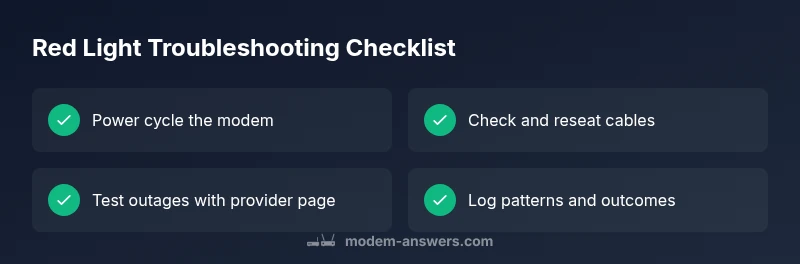
Before grabbing a screwdriver or calling your provider, run through these basics. Power cycle the modem by unplugging it for 60 seconds and plugging it back in. Inspect the power adapter for warmth or damage, and verify the outlet works by testing another device. Check every coaxial and Ethernet cable connected to the modem—look for visible damage, kinks, or loose connectors and reseat firmly. If you’re using a battery backup or surge protector, temporarily bypass it to rule out interference. Finally, check your service status page with your ISP to see if there’s a known outage in your area.
Common causes of a red light and how to diagnose
Red lights are usually linked to one of a few core issues: (1) power or power supply faults, (2) loose or damaged cables, (3) ISP outages or provisioning problems, (4) firmware crashes or outdated software, (5) overheating or ventilation problems, and (6) rare hardware failure. Start by eliminating the simplest causes—power and cables. If the cables are intact and the light remains red, move on to service status and firmware checks. Document any blink patterns, as rapid alternatives can indicate different faults.
Diagnostic flow overview
A practical diagnostic flow helps you move from symptom to solution with minimal frustration. Begin with the most common, easy fixes, then escalate to outages or firmware issues. If you’re unsure about any step, skip ahead to safety and professional help. The goal is to determine whether the problem is local (your equipment), external (ISP), or hardware failure requiring replacement.
Step-by-step fix: power and connection issues
- Power cycle: unplug the modem, wait 60 seconds, plug back in, and allow it to boot fully. 2) Verify the power adapter is functioning and not overheating; replace if damaged. 3) Reseat all coaxial and Ethernet cables; ensure tight connections and no visible damage. 4) Check for any surge protectors or power strips that could restrict power delivery and test directly to a wall outlet. 5) If you notice persistent red light, perform a safe factory reset after backing up essential settings. 6) Reconnect and verify how lights respond post-reset, noting any change. 7) If issues persist, contact your provider for line tests and potential equipment replacement.
Step-by-step fix: signal and service issues
- Access your modem's admin page to view signal levels, especially downstream/upstream power and SNR values. 9) If the admin page shows abnormal levels, attempt a firmware update or check for a pending provisioning change from the ISP. 10) Re-test with a different device to rule out a device-specific problem. 11) Run a line test via the provider’s diagnostic tools, and request a technician visit if measurements remain out of spec. 12) If a service outage is reported, follow the provider’s guidance and wait for restoration. 13) After outages or firmware actions, re-test connectivity and document results.
When to contact your provider and potential replacement
If you’ve completed the above fixes and the red light remains, it’s time to escalate. Persistent red lights can indicate hardware failure or a damaged line that needs professional testing. Contact your provider to schedule a technician visit or discuss a replacement modem. If your device is old or unsupported, replacement may be the fastest path to stable service.
Safety, data, and device handling notes
Never attempt to disassemble internal modem components. Avoid using damaged cables or power adapters, as they can pose shock or fire risks. Back up essential network settings only after you regain connectivity, to prevent loss of configuration during resets. If you’re unsure about any step, pause and call for professional help—safety and data integrity are more important than a quick fix.
Prevention and ongoing maintenance to avoid red lights
To reduce future red-light occurrences, keep the modem in a well-ventilated area away from heat sources, dust, and moisture. Use quality cables and connectors, avoid daisy-chaining devices, and perform regular firmware checks through the provider’s app. Maintain a simple troubleshooting log noting when issues start, what actions you took, and the results. Regularly testing your setup helps catch issues before they impact your internet uptime.
Steps
Estimated time: 30-60 minutes
- 1
Power cycle the modem
Unplug the modem, wait 60 seconds, then plug it back in. Allow 3-5 minutes for the device to boot and re-establish connections. Watch for changes in the red light as it stabilizes.
Tip: Record the exact time you restarted to correlate with any outage notices. - 2
Check power and cables
Inspect the power adapter and replace if any warmth, cracking, or damage is visible. Reseat the coax and Ethernet cables firmly, ensuring there are no bent pins or loose ends.
Tip: Use a different power outlet to rule out outlet issues. - 3
Test for outages
Visit your ISP’s outage page and search for service issues in your area. If there’s a reported outage, you may simply need to wait. If not, continue with the on-device checks.
Tip: Take a screenshot of the outage page for reference when calling support. - 4
Access the modem admin page
Log into the admin interface to view signal values (downstream/upstream power, SNR). Compare against typical healthy ranges in your model’s documentation.
Tip: If you can’t reach the admin page, try a direct browser URL like http://192.168.0.1. - 5
Reset or update firmware
If required, perform a safe factory reset and reconfigure settings. Alternatively, apply any available firmware updates via the provider’s app or admin page.
Tip: Back up important network settings before resetting. - 6
Test devices and ports
Check connectivity with multiple devices and ports (Wi-Fi and wired). If one device works, the issue may be device-specific. If none do, the problem is likely the modem or line.
Tip: If only one device has issues, check its network profile and DNS settings. - 7
Escalate if unresolved
If you’ve completed basic and intermediate steps and the red light persists, contact your ISP for line tests or request a replacement modem.
Tip: Document all steps you've taken to speed up service when you call.
Diagnosis: Modem shows a solid red light or no lights at all
Possible Causes
- highPower issue or faulty power supply
- highLoose, damaged, or unplugged coax/ethernet cable
- mediumISP outage or service interruption
- mediumFirmware crash or outdated software
- lowOverheating due to blocked ventilation
- lowHardware modem failure
Fixes
- easyPower cycle the modem: unplug for 60 seconds, then plug back in and wait for it to boot fully
- easyInspect and reseat power adapter; replace if warm or damaged
- easyCheck coax and ethernet cables for damage and tighten connections
- easyCheck service status with your provider and run a line test via the admin page
- mediumIf lights stay red after basics, perform a factory reset (only if you can reconfigure) or call support
- hardUpdate firmware through the provider's app or replace the modem if hardware fault is suspected
- mediumIf the issue persists, consider hardware replacement or professional technician visit
FAQ
What does a red light on my modem mean?
A solid red light usually indicates a hardware or connection issue, such as power, signal, or firmware faults. Start with power cycling and cable checks before moving to firmware updates or provider contact.
A red light usually means a hardware or connection problem. Begin with a power cycle and cable checks, then move to firmware updates or call your provider.
Should I unplug and replug the modem when I see a red light?
Yes. Power cycling is the first recommended step for almost all red-light issues. It resets internal hardware and can re-establish a good connection.
Yes—power cycle first. It resets the hardware and often resolves the issue.
What is the difference between red and amber lights on a modem?
Red usually indicates a more critical fault (hardware or provisioning), while amber typically points to a less severe issue like updating firmware or a minor signal issue.
Red means more serious fault; amber is less severe, often updating or minor signal trouble.
What should I do if there’s an ISP outage?
Check the service status page of your provider. If an outage is reported, wait for restoration and avoid performing unnecessary resets.
If there’s an outage, wait for the provider to fix it and avoid extra resets.
Can a factory reset fix firmware problems?
A factory reset can resolve some firmware issues by returning the device to a known state, but you’ll need to reconfigure settings afterward.
A reset can fix firmware issues, but you’ll have to set up the modem again.
When should I replace the modem?
If hardware failure is confirmed or the device is outdated and unsupported, replacement is often the fastest path to stable service.
If the hardware is failing or the model is outdated, replacement is often best.
Watch Video
Key Takeaways
- Power cycle first; it fixes many red-light issues.
- Verify all cables are intact and firmly connected.
- Check for ISP outages before assuming hardware failure.
- Back up settings before performing a factory reset.
- If problems persist, contact your provider promptly for diagnostics or replacement.