e31n2v1 Error Guide: Quick Fixes and Step-by-Step Troubleshooting
A comprehensive, step-by-step guide to diagnosing and fixing the e31n2v1 modem error, with quick checks, diagnostic flow, and professional tips. Learn fast, safe remedies and when to call your provider. By Modem Answers Team.


e31n2v1 is a modem error code signaling a link or authentication failure between your device and the ISP. The quickest fix is a power-cycle: unplug, wait 30 seconds, and plug back in, then verify cable connections. If the error remains, perform a factory reset of the modem (careful about losing custom settings) or contact your provider for a line check.
Understanding e31n2v1 on Your Modem
The error code e31n2v1 is not just a random alert. It indicates a breakdown in the critical handshake between your modem and the Internet Service Provider (ISP). In practical terms, this means your modem can see the network, but authentication or a stable link cannot be established. For homeowners and renters, this kind of fault can arise from simple issues like loose cables or a temporary service hiccup, or from more stubborn problems like outdated firmware or a failing modem. The Modem Answers team emphasizes urgency with this error because even a minor delay can affect work, schooling, and access to essential services. By understanding the mechanics behind e31n2v1, you can triage effectively and reduce downtime while you work toward a durable fix. The keyword here is reliability: you need a plan that not only clears the code once, but keeps the connection stable moving forward. This guide centers on practical steps you can take today, with clear instructions and safe precautions. e31n2v1 is the kind of error that benefits from a calm, methodical approach rather than guesswork, and Modem Answers stands ready to guide you through it.
Immediate checks you can perform now
If you’re staring at e31n2v1, start with the quickest, least disruptive actions. First, confirm that the service is not down in your area by checking the ISP status page or calling the provider’s outage line. Next, perform a power cycle: unplug the modem (and router if you have one), wait 30 seconds, then plug back in. While it’s unplugged, inspect all visible connectors—coaxial cables, Ethernet cables, and power cords—for snugness and visible damage. Reconnect everything firmly and wait for the modem to boot fully. If the problem persists, try a different power outlet and remove any surge protectors temporarily to rule out power delivery issues. Record the time you performed these steps; timing can help support staff correlate outages or outages with firmware push windows. If you can access the modem’s admin page, take a quick look for any warning lights or recent error messages that can guide troubleshooting. Remember: you’re addressing both the physical layer (cables, power) and the logical layer (authentication). The Modem Answers team notes that this stage alone resolves a large share of e31n2v1 incidents when performed promptly.
Common ISP-side and hardware causes
When the quick checks don’t clear e31n2v1, the next layer to inspect is the combination of ISP-side conditions and hardware integrity. A high likelihood cause is a service outage or a line fault that prevents proper registration with the network. If the line is fine, a loose or damaged coax or Ethernet cable, a poorly seated modem, or a failing power supply can mimic an ISP problem. Firmware glitches on the modem can also trigger e31n2v1, especially after an automatic update that didn’t install cleanly. Overheating can force the device to throttle or reset briefly, leading to authentication events failing. To test these causes, swap cables with known-good ones, connect the modem directly to a wall outlet (bypassing power strips), and observe the indicator lights for signs of abnormal behavior. If you observe repeated resets, check for firmware update prompts and verify that the version matches what the manufacturer recommends. In addition, verify that you aren’t exceeding the maximum number of connected devices, which can sometimes trigger authentication limits on certain plans. The Modem Answers team’s troubleshooting framework emphasizes systematically ruling out each potential fault in a logical order. e31n2v1 is often resolved by addressing the physical link first, then validating the network authentication process.
How to perform a reliable power-cycle and reset
A deliberate power-cycle is one of the most effective, low-risk remedies for e31n2v1. Start by unplugging the modem and, if applicable, the router. Wait at least 30 seconds to allow residual capacitors to discharge. Reconnect the modem first, then the router, and wait for all status lights to stabilize—this may take a couple of minutes. If there is a dedicated reset button, use a pin or paperclip to hold it for 10 seconds to restore factory defaults, but only after a successful power-cycle. A factory reset can erase saved network credentials and custom port mappings, so you’ll need to reconfigure Wi‑Fi name (SSID), password, and any port-forward rules. If your model supports a dual-band configuration, consider re-creating both the 2.4 GHz and 5 GHz networks from scratch. After reset, check if e31n2v1 reappears; if so, proceed to check the ISP line, request a line test, and consider a technician visit. This sequence balances safety, practicality, and speed, which is crucial when you’re facing an urgent connectivity issue.
Validation and next steps after the initial fix
Once you’ve implemented power-cycle and possible reset, re-run a basic validation: can you access the modem’s admin page, can you browse the web from a wired device, and does the LAN/WAN status show active. If the status remains ambiguous, perform a controlled test by connecting a single computer directly to the modem to isolate router-related interference. If you still see e31n2v1, capture the event by noting the exact time, connected devices, and any error messages visible on the screen. This evidence helps support staff perform faster remote diagnostics or on-site visits. If the issue recurs, escalate to your ISP with the evidence you collected: outage status, connection history, and the steps you’ve already attempted. In many cases, repeated occurrences indicate a more complex problem that requires professional service or a replacement device under warranty. The Modem Answers team stresses timely escalation once basic troubleshooting has been exhausted to avoid prolonged downtime.
Prevention: maintaining long-term modem health
To prevent frequent e31n2v1 occurrences, implement routine maintenance and environment management. Keep firmware up to date in approved, device-specific channels and enable automatic updates if your model supports them. Place the modem in a well-ventilated, dust-free area away from heat sources and direct sunlight to minimize overheating; ensure there’s adequate clearance around vents. Use quality cables and replace any showing wear, avoiding cheap third-party micro-coax hacks that can introduce subtle faults. Regularly test your connection with a quick speed test after routine resets or power interruptions, and document results to detect slow degradation in performance. If you’ve configured a complex home network (multiple access points, mesh nodes, or a business-grade firewall), periodically review settings to ensure they aren’t inadvertently blocking the essential authentication traffic. By adhering to these proactive steps, you reduce the probability of e31n2v1 reappearing and improve overall reliability—an outcome that aligns with Modem Answers’ commitment to practical, field-tested guidance.
Steps
Estimated time: 30-45 minutes
- 1
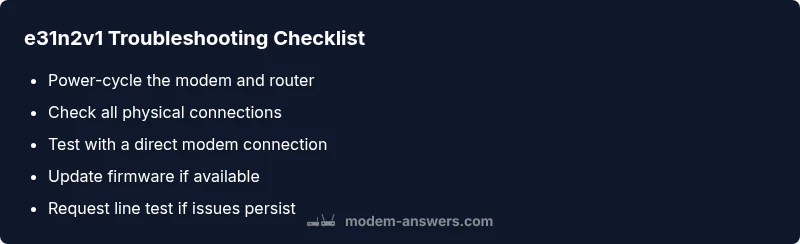
Power-cycle the modem (and router)
Unplug the modem and router, wait 30 seconds, plug the modem back in, then reconnect the router. Allow 2–3 minutes for full boot. If the lights stabilize to a normal pattern, run a quick connectivity test.
Tip: Make sure to unplug from the wall outlet, not just from a surge protector. - 2
Inspect and reseat cables
Check the coax and Ethernet cables for nicks or kinks. Unplug and re-seat both ends securely. If possible, swap in known-good cables to eliminate a faulty lead as the culprit.
Tip: Tighten connections until they’re finger-tight—no tools needed. - 3
Check for firmware updates
Log into the modem’s admin page to see if a firmware update is pending. If available, apply the update and reboot. If the update fails, perform a clean reflash from the manufacturer’s official site.
Tip: Only use the official firmware from the OEM; avoid third-party firmware. - 4
Test with a direct modem connection
Disconnect any router and connect a computer directly to the modem with an Ethernet cable. Verify if you can reach websites to isolate router-related issues.
Tip: If direct connection works, the problem may be router or network config related. - 5
Factory reset if necessary
If problems persist after the above steps, perform a factory reset on the modem and reconfigure your network from scratch. Preserve essential credentials and note down your Wi-Fi SSID and password.
Tip: Only reset after you’ve saved important settings; otherwise you’ll have to re-create port forwards and firewall rules.
Diagnosis: Error code e31n2v1 displayed on modem UI or lights, with intermittent or no Internet
Possible Causes
- highService outage or line fault
- highLoose or damaged coax/Ethernet cable
- mediumModem firmware glitch
- lowOverheating or power supply issue
Fixes
- easyPower-cycle the modem (and router) and re-seat all cables
- easyReplace suspect cables and test direct modem connection
- mediumUpdate or reflash modem firmware from the official source
- mediumPerform a factory reset if EMI/reboots persist, then reconfigure network
- hardRequest a line test or technician visit from ISP
FAQ
What does e31n2v1 mean on my modem?
e31n2v1 signals a problem with the link or authentication between your modem and the ISP. It typically arises from a failed handshake or a hardware/firmware glitch and may require both quick checks and deeper troubleshooting.
e31n2v1 means your modem isn’t able to authenticate with the ISP, so you need to check cables, power, and possibly reset the modem.
Is e31n2v1 usually ISP-side?
Often yes, especially if a service outage or line fault is reported. Start by checking the ISP status page and waiting a short period before escalating.
Most often it’s an ISP-side issue, but it can also be a faulty cable or a misconfiguration on your end.
Will a factory reset erase my settings?
Yes. A factory reset restores default factory settings, erasing saved networks and port forwards. You’ll need to reconfigure Wi‑Fi, reconnect devices, and reapply custom settings.
A factory reset will wipe your custom settings, so back up if you can before you do it.
If e31n2v1 persists, should I replace the modem?
If the issue remains after diagnosing lines, updating firmware, and testing with a direct connection, a hardware fault is likely. Check warranty and consider replacement from the manufacturer.
If nothing else fixes it, a replacement modem under warranty is a sensible next step.
How long does troubleshooting typically take?
Initial checks and power-cycles take 10–20 minutes. Firmware updates or resets can extend to 30–60 minutes, with ISP testing potentially adding more time.
Most fixes fall within a 30 to 60 minute window, depending on the complexity.
When should I call a professional?
If you have repeated outages, persistent e31n2v1 after all basic steps, or if your service is under warranty but unresolved, schedule a technician visit with your provider or a licensed technician.
If the problem keeps coming back after all steps, a professional should be involved.
Key Takeaways
- Initiate with a power-cycle to clear many e31n2v1 cases
- Secure every physical connection before deeper troubleshooting
- If the issue persists, escalate to ISP for line testing or a replacement
- Document steps and test results to speed support