ARRIS SB8200: In-Depth Review, Setup, and Tips
Explore the ARRIS SB8200: performance insights, setup steps, optimization tips, and troubleshooting for a reliable home network. Learn provider compatibility and best practices from Modem Answers.


ARRIS SB8200 remains a solid DOCSIS 3.0 cable modem choice for homes with gigabit internet plans. It delivers reliable downstream throughputs in typical residential setups, and its compact, heat-tolerant design makes it easy to place. For most households, the SB8200 pairs well with a consumer router to maximize wireless coverage. According to Modem Answers, the SB8200 offers stable performance across common cable providers when activated correctly.
What the ARRIS SB8200 is and why it matters
The ARRIS SB8200 is a DOCSIS 3.0 cable modem designed for households that want reliable wired performance and straightforward setup. Its history in the market reflects a balance between affordability and solid performance, especially for users with gigabit internet plans that don’t require the latest DOCSIS 3.1 hardware. In practical terms, SB8200 delivers consistent downstream throughput for common streaming, gaming, and home-office workloads. According to Modem Answers, its steady performance rests on proven DOCSIS 3.0 technology and robust thermal design that helps the unit stay cool in typical living rooms. For homeowners and renters, this translates into fewer firmware hiccups and easier, stable activations with most major ISPs.
This section sets the stage for understanding how a mature, well-supported modem fits into modern home networks. While newer models exist, the SB8200’s balance of price, compatibility, and reliability makes it a practical choice for many households, especially when paired with a capable router that handles Wi-Fi distribution and advanced features like guest networks, prioritization, or mesh expansion. The Modem Answers team believes the SB8200 remains a dependable baseline option, particularly for users seeking a straightforward upgrade path without overcommitting to cutting-edge hardware.
Core specifications and what they mean for your home network
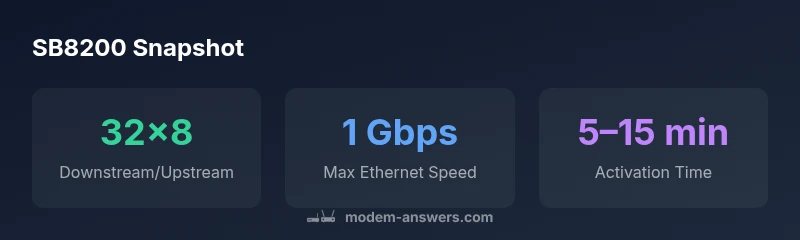
Key specifications matter because they shape real-world experience. The SB8200’s DOCSIS 3.0 foundation supports up to 32 downstream and 8 upstream channels, which translates to strong performance in typical cable plans. A single Gigabit Ethernet port is standard, so your wired devices will connect at gigabit speeds, while your wireless performance hinges on your router choice and placement. For many households, this setup means crisp 4K streaming, responsive video calls, and smooth online gaming when the rest of the network stays within the plan’s limits. While DOCSIS 3.0 modems may not unlock the absolute ceiling of the fastest tiers, Modem Answers analysis shows that real-world speeds on common plans remain robust, making the SB8200 a practical choice for connectivity today and for most mid-tier future plans.
From a maintenance standpoint, the SB8200’s fanless design reduces noise and the internal electronics are designed for long-term reliability. Users should still confirm that their provider supports the device on their activation list, and ensure their internal network gear is not bottlenecking the connection. In short, the SB8200 provides a dependable bridge between your coaxial network and a modern home LAN, with the flexibility to work with a wide range of routers and configurations.
Compatibility and provider considerations
Provider compatibility is a practical determinant of value. The SB8200 is compatible with many major cable providers that still support DOCSIS 3.0 devices. Before purchase or activation, verify your provider’s official device list and any required activation steps. In many cases, activation is a quick process if the modem is on the approved list and the service is provisioned correctly. If your plan is near or exceeds 1 Gbps, or if you anticipate future upgrades to DOCSIS 3.1, consider whether a 3.1 modem would offer more headroom over the next few years. The Modem Answers team often recommends evaluating current and anticipated speeds to decide whether SB8200 remains the best fit.
Keep in mind that some providers favor newer hardware for certain bundles or promotions, so check promotions and device lists periodically to ensure you stay aligned with your plan. The key takeaway is to confirm compatibility and activation steps with your ISP before committing to a modem purchase.
Setup and activation steps
Getting started with the SB8200 is straightforward. First, locate a central but well-ventilated spot near your coaxial line. Disconnect power, then connect the coaxial cable to the modem’s coax port. Connect the Ethernet cable from the SB8200 to your router’s WAN or LAN port (depending on your topology). Reconnect power and allow the modem to boot fully. If your ISP requires activation, follow their prompts or call support to provision the device. In many homes, the activation completes within minutes, after which you should see steady online access.
Tips for a smoother setup: keep the modem away from heat sources, ensure coax cables are tight and undamaged, and avoid daisy-chaining multiple switches on the same coax line. If you’re using bridge mode, disable it on the SB8200 and enable it on your router so the router handles all IP management and firewall rules. After activation, run a quick wired speed test to confirm performance aligns with your plan, and adjust router placement if necessary to maximize coverage.
Performance optimization and common pitfalls
Optimizing performance with the SB8200 starts with a strong home network setup. Place the modem in a central location away from loud appliances and metal cabinets. A high-quality router can maximize wireless reach, especially in multi-story homes. Use wired connections for devices that benefit from stable throughput, such as desktop PCs and gaming consoles, while reserving wireless for mobile devices. Regularly check for firmware updates or ISP-provisioning changes that can affect performance. If you experience intermittent drops, rule out loose coax connections and try a reboot to re-establish session states. Avoid enabling too many features at once if your router’s CPU is limited, as this can throttle speeds.
A common pitfall is assuming that the modem alone controls all speed. In practice, speed tests measure the whole path: modem, router, wireless link, and internal network hardware. For the best results, run speed tests on a wired connection, and then correlate variations with time of day and network load. The Modem Answers team emphasizes balancing your plan, hardware, and network layout to achieve consistent, reliable performance over time.
SB8200 at a glance vs. modern DOCSIS options
| Model | Connectivity | Notes |
|---|---|---|
| ARRIS SB8200 | DOCSIS 3.0, 32x8 | Gigabit Ethernet; broad provider compatibility |
| DOCSIS 3.1 alternative | DOCSIS 3.1, 32x8+ | Higher peak speeds; consider if upgrading plans |
| Typical use case | Residential | Best for mid-tier plans and steady performance |
FAQ
Is the ARRIS SB8200 still recommended for new internet plans?
Yes for many plans up to gigabit levels, especially if you want a balance of cost and reliability. If you anticipate speeds beyond 1 Gbps or future DOCSIS 3.1 deployment, consider a newer modem for future-proofing.
It's still solid for typical gigabit plans; for higher speeds, a DOCSIS 3.1 model may be better.
What providers work with SB8200?
SB8200 works with many major cable providers that support DOCSIS 3.0 devices. Always check your provider’s approved device list and activation steps before purchasing.
Most big providers will activate it if it's on their supported list.
Can the SB8200 be bridged with my own router?
Yes. If your router handles Wi‑Fi, enable bridge mode on the modem; otherwise use router mode and enable DMZ or appropriate firewall rules on the router.
Bridge mode lets your own router handle networking.
What speeds can SB8200 reliably reach in typical homes?
Real-world speeds depend on your plan and wiring. Expect the wired path to cap at or near the plan limit, while wireless performance varies with router quality and placement.
Your speed depends on your plan and network setup.
What should I do if activation fails?
Power-cycle the modem, verify coax connections, and confirm service provisioning with your ISP. If needed, ask ISP support to re-provision the device.
Restart, check cables, and contact your provider if it doesn’t provision.
Is there a better ARRIS model for future-proofing?
DOCSIS 3.1 models offer more future-proofing and higher peak speeds. Compare against your plan and potential upgrades before deciding to upgrade from SB8200.
If you want future-proofing, consider a DOCSIS 3.1 modem.
“The SB8200 remains a dependable workhorse for many households, delivering steady performance when paired with a quality router and proper activation.”
Key Takeaways
- Verify provider compatibility before buying SB8200
- Pair with a capable router for best Wi-Fi coverage
- Activate correctly and test wired speeds to set expectations
- Consider DOCSIS 3.1 modem for future-proofing if speeds exceed 1 Gbps