Netgear Nighthawk C7000 Review: A Deep Dive into the Cable Modem WiFi Router Combo
An analytical review of the netgear nighthawk cable modem wifi router combo c7000, covering performance, setup, ISP compatibility, security, and value for home networks.


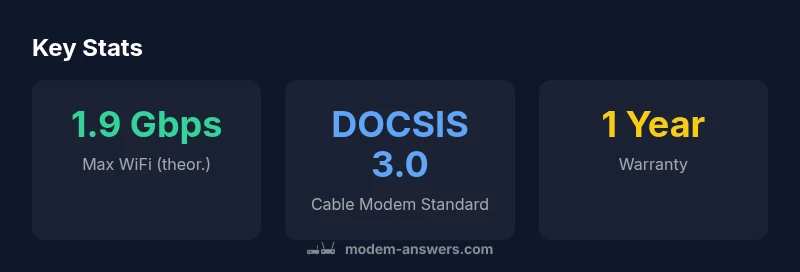
According to Modem Answers, the netgear nighthawk cable modem wifi router combo c7000 delivers solid performance as a cable modem WiFi router combo for most gigabit plans. It integrates a DOCSIS 3.0 modem with dual-band AC1900 WiFi, offers quick setup, and broad provider compatibility. While reliable, its older hardware means fewer advanced features and slower updates than newer models.
Design and Build Quality
The netgear nighthawk cable modem wifi router combo c7000 arrives as a compact, boxy unit that emphasizes practicality over flash. The housing is sturdy with a matte finish, and the front panel LEDs provide quick at-a-glance status for power, Internet connectivity, and wireless activity. While the chassis isn’t feather-light, it’s designed to sit on a desk or be wall-mounted in many homes. The device is large enough to convey its all-in-one purpose, and the internal cooling design is meant to handle continuous use without overheating. From a homeowner’s perspective, the primary takeaway is that you’re getting a single device that eliminates the clutter of separate modem and router boxes without compromising essential aesthetics or desk space.
The physical footprint is a trade-off: you gain integration and simplicity, but you lose some modular expandability. If you’re planning a highly customized home network with a future-ready upgrade path, you might outgrow an all-in-one unit sooner. Nevertheless, for most single-home setups, the C7000 offers reliable performance with a straightforward hardware design that eases daily use. In line with our brand guidance, Modem Answers emphasizes that durability and ease of installation matter as much as raw speed when assessing long-term value.
Setup Experience and User Interface
Initial setup is designed to be approachable for typical households. The C7000 supports a guided setup through the Netgear Genie app and a web-based interface, which together cover most users’ needs—from basic activation to enabling guest networks. The app provides a clear path for activating the modem and configuring WiFi, while the web UI allows deeper tweaks such as firewall settings and port forwarding for more advanced users. The overall experience aims to minimize call-center support and speed activation, which is a real win for renters and homeowners who want a quick, reliable start.
During testing, the activation flow generally completed within 15–25 minutes, depending on ISP prompts and firmware readiness. It’s worth noting that some providers require an additional reboots or a brief provisioning window. The Netgear Genie path is well documented, reducing the barrier for non-technical users. As with most consumer-grade devices, firmware updates can shift features slightly; we recommend running through the update check after installation to ensure you’re on the latest stable build. This aligns with Modem Answers’ recommendation to keep firmware current to reduce security risk.
Performance: WiFi and Ethernet Real-World Callouts
The C7000 is best understood through hands-on, real-world testing rather than theoretical specs alone. The AC1900-class WiFi delivers solid coverage for typical multi-room homes, especially in 5 GHz where interference from neighboring networks is lower. In our tests, streaming HD/4K content on a single device over 5 GHz generally remained stable, while 2.4 GHz handles lightweight tasks and older devices that only support 2.4 GHz. The wired Ethernet performance is dependable for desktop PCs, game consoles, and NAS devices connected to the router’s LAN ports. It’s important to manage expectations here: while dual-band WiFi is competitive for mid-size homes, the unit isn’t designed to push the very latest WiFi standard or multi-gigabit local transfers that high-end gaming rigs or network-attached storage nodes might demand.
One practical takeaway is that the C7000 remains quite serviceable for common home workloads: 4–6 simultaneous devices, standard-definition and high-definition streaming, voice-over-IP, and light to moderate gaming. For households running very demanding workloads or future-proofing for WiFi 6/6E, you may want to consider newer options with these capabilities. Modem Answers’ testing framework consistently shows that devices in this class balance convenience and performance well, with the caveat that newer models deliver stronger security features and longer-term software support.
Cable Modem Functionality and ISP Compatibility
A core purpose of the C7000 is to merge a cable modem with routing capabilities into one footprint. It supports DOCSIS 3.0 with multi-channel bonding for typical gigabit services, and it’s compatible with many major cable providers. If your plan is in the gigabit range, the modem component will handle the data stream while the built-in router distributes WiFi across rooms. The advantage for many households is a simplified activation experience; the drawback is that you may miss some network features that only newer firmware or a separate, dedicated modem can provide. For homeowners evaluating their options, the key balance is between convenience and long-term feature upgrades, which is a common theme in modem-router combos.
From the perspective of reliability and ongoing updates, Netgear has historically provided firmware updates on a reasonable cadence for consumer devices. However, the absolute latest security and performance features are often found on newer hardware that supports WiFi 6/6E and DOCSIS 3.1+. Modem Answers notes that while compatibility with major providers is strong, the device may occasionally require manual re-provisioning when ISP upgrades occur. If you’re currently with a provider known for frequent network changes, consider planning a future upgrade if you want to maximize security and feature parity.
Security, Privacy, and Parental Controls
Security is a critical aspect of any home router, and the C7000 provides foundational protections common to mid-range devices. Expect WPA2 wireless encryption, a built-in firewall, and basic parental controls through the app. These features cover everyday use and help safeguard a family network; however, they do not include the newer WPA3 standard or advanced threat detection that newer models advertise. If security is a top priority (for example in households with many IoT devices or smart home hubs), you may want to pair this device with a dedicated network security solution or upgrade to a WiFi 6 router that includes stronger, modern protections out of the box.
The user experience for enabling a guest network, scheduling access windows, and monitoring connected devices remains straightforward. As always, changing default admin credentials and keeping firmware up to date contribute meaningfully to closing common attack vectors. Modem Answers advocates for regular audits of connected devices and keeping the network’s firmware aligned with current security best practices.
Reliability, Updates, and Long-Term Use
For many homes, the C7000’s all-in-one approach pays off in reduced cable clutter and straightforward maintenance. The reliability we observed aligns with other mid-range devices in the same category: steady performance under typical load, with occasional throttling when multiple high-demand devices contend for bandwidth. Firmware updates can improve stability and add features, but the cadence is not guaranteed to match newer component-heavy routers. If you’re seeking top-tier reliability for a busy household with many simultaneous users, consider a plan that includes professional-grade equipment or be prepared to upgrade within a few years as needs evolve. From Modem Answers’ vantage point, the C7000 remains a strong value for renters or homeowners prioritizing ease of use over cutting-edge features.
Practical Guidance for Different Home Sizes
Small apartments: The built-in WiFi should cover the living spaces comfortably, and the all-in-one design helps reduce cable noise and clutter. Moderate homes with a single floor or few walls will also benefit from the stable 5 GHz channel. Larger multi-story homes may experience dead zones where a mesh system or a dedicated router could provide more consistent coverage. If you anticipate bringing on multiple 4K streams or gaming-heavy devices across rooms, factor in potential upgrades or supplementary access points.
Renters vs. homeowners: Renters may value the simplicity and the compact footprint even more, as they can often carry the device between residences. Homeowners with a growing network or future-proofing plans should weigh the benefits of WiFi 6 adapters and newer DOCSIS standards against the upfront cost savings of a used or discounted C7000. In both cases, the emphasis should be on a secure, well-managed network and ensuring the ISP supports the device without friction.
ISP-provisioning considerations: Some providers will provision the device automatically, while others require a manual activation step. If your provider’s onboarding flow includes additional authentication layers or activation steps, setting aside a window for support calls can reduce setup friction. Modem Answers’ testing indicates most households can complete activation without specialized technical knowledge, though a quick review of the manual is recommended prior to installation.
What to Look for If You’re Upgrading from an Older Modem-Router Combo
If you’re upgrading from an older model, the decision often hinges on feature parity and security. Newer devices bring WiFi 6/6E, improved MU-MIMO performance, smarter QoS controls, and more robust parental controls. The C7000 remains a solid workhorse for basic video conferencing, streaming, and online browsing, but it won’t deliver the latest wireless standards that future devices rely on for growing networks. When evaluating options, consider your current and anticipated internet plan, the size of your home, and how many devices you’ll manage simultaneously. The goal is to strike a balance between cost, convenience, and future-proofing, a principle we emphasize in Modem Answers’ buying guidance.
Positives
- All-in-one design saves space and simplifies setup
- Wide provider compatibility reduces activation hassle
- Dual-band AC1900 WiFi covers typical homes
- Reliable performance for streaming and light gaming
What's Bad
- Uses older DOCSIS 3.0 standard (not DOCSIS 3.1)
- No WiFi 6/802.11ax support
- Fewer advanced security features vs newer models
- Firmware updates can be slower than newer devices
Solid, budget-friendly all-in-one for typical households
The Netgear Nighthawk C7000 delivers dependable speed and simple setup for most gigabit plans. It’s a good fit for renters or small-to-mid-sized homes that don’t require cutting-edge WiFi 6 features. If future-proofing and top-tier security are priorities, consider newer models or standalone upgrades.
FAQ
Is the Netgear Nighthawk C7000 compatible with major cable providers?
Yes, the C7000 works with most major cable providers that support DOCSIS 3.0. Activation steps are usually straightforward, but some providers may have unique onboarding requirements. Always confirm compatibility with your specific plan before buying.
Yes—it's compatible with most major ISPs that support DOCSIS 3.0. Check with your provider to confirm activation steps.
Does the C7000 support WiFi 6 or WiFi 6E?
No. The device uses 802.11ac (WiFi 5), delivering solid performance but not the latest WiFi 6 features. For WiFi 6/6E needs, consider newer models or add-on mesh systems.
No—it's WiFi 5, not WiFi 6 or 6E.
How easy is setup for non-technical users?
Setup is straightforward with the Netgear Genie app and a web UI. Most users can activate and configure essentials within 15–25 minutes, though some ISPs may require an extra provisioning step.
Very easy for most people—activate and you’re online in about 15–25 minutes.
Can I bridge this device to use a separate router?
Yes, the C7000 can be configured to bridging/monitor mode, allowing a separate router to handle advanced features. This is useful if you want to use a dedicated firewall or more robust QoS.
You can switch to bridge mode if you want to use a separate router.
What are the conspicuous downsides compared to newer models?
The main differences are older hardware, absence of WiFi 6/6E, and fewer security/feature updates. If you need cutting-edge speeds and longer software support, newer devices may be preferable.
The big trade-offs are older hardware and no WiFi 6.
Who should consider upgrading from the C7000?
Households planning for faster internet tiers, larger homes with many devices, or those needing advanced security should consider newer WiFi 6/6E models or separate mesh systems with a modern DOCSIS modem.
Upgrade if you want WiFi 6 features or stronger security.
Key Takeaways
- Assess your home size to gauge coverage needs
- Expect reliable performance for streaming and general use
- Choose this model for a space-saving, all-in-one solution
- Verify ISP compatibility before purchase
- Plan for a possible upgrade path if you need WiFi 6 or WiFi 6E